Introduction
The property management industry is experiencing a major operational shift. Real estate businesses are no longer managing just buildings and tenants. They manage data, communication, maintenance workflows, compliance, financial operations, and customer expectations simultaneously. As property portfolios continue growing, traditional management methods are becoming harder to sustain.
For years, many property management teams relied on spreadsheets, emails, phone calls, and disconnected software tools to handle day-to-day operations. While those systems worked on a smaller scale, they often created delays, communication gaps, repetitive administrative work, and limited operational visibility. Property managers spend too much time reacting to problems rather than improving efficiency.
Artificial intelligence is beginning to solve many of these challenges. Instead of functioning as simple record-keeping systems, modern property management platforms are becoming intelligent operational ecosystems capable of automation, prediction, analysis, and real-time decision support.
In this blog, we will explore how AI features are transforming property management software, why real estate companies are rapidly adopting intelligent systems, and what the future of AI-driven property operations looks like.
Key Takeaways
- App AI reduces manual workload through workflow automation and predictive systems
- Intelligent property management platforms improve tenant communication and operational visibility
- Predictive analytics help reduce maintenance costs and operational disruptions
- Real estate businesses are using AI to improve efficiency, scalability, and decision-making
- AI-powered software is becoming a long-term competitive advantage in property management
What Is AI-Powered Property Management Software?
Property management software is traditionally focused on storing tenant records, tracking rent payments, and managing maintenance tickets. While useful, those systems mostly depend on manual updates and human oversight.
AI-powered property management software goes far beyond basic administration.
These systems process large volumes of operational data and use machine learning, automation, and predictive analytics to improve how properties are managed daily. Instead of only organizing information, the software actively identifies patterns, predicts operational risks, automates workflows, and supports business decisions.
The system gathers data from multiple operational sources such as:
- Lease agreements
- Tenant communication history
- Payment records
- Maintenance logs
- IoT sensors
- Building systems
- Utility usage
- Occupancy trends
By continuously analyzing this information, AI-powered platforms help property managers operate more efficiently while reducing repetitive administrative work.
This shift is transforming property management from reactive operations to data-driven operations.
Why Property Management Companies Are Turning Toward AI
The growing complexity of real estate operations is one of the main reasons AI adoptions is accelerating.
Managing multiple properties involves constant coordination between tenants, vendors, maintenance teams, leasing departments, finance teams, and operational managers. Without centralized intelligent systems, delays and inefficiencies become unavoidable.
Many property companies still struggle with:
- Delayed maintenance responses
- Slow communication between teams
- High operational costs
- Manual reporting processes
- Missed lease renewal opportunities
- Inconsistent tenant experiences
- Limited real-time operational visibility
AI features directly address these operational problems by improving speed, automation, and accuracy.
According to McKinsey Digital Insights, businesses across operational industries are increasingly investing in AI to improve efficiency, reduce costs, and support faster decision-making.
Real estate technology is now following the same path.
How AI Features Are Reshaping Property Management Software
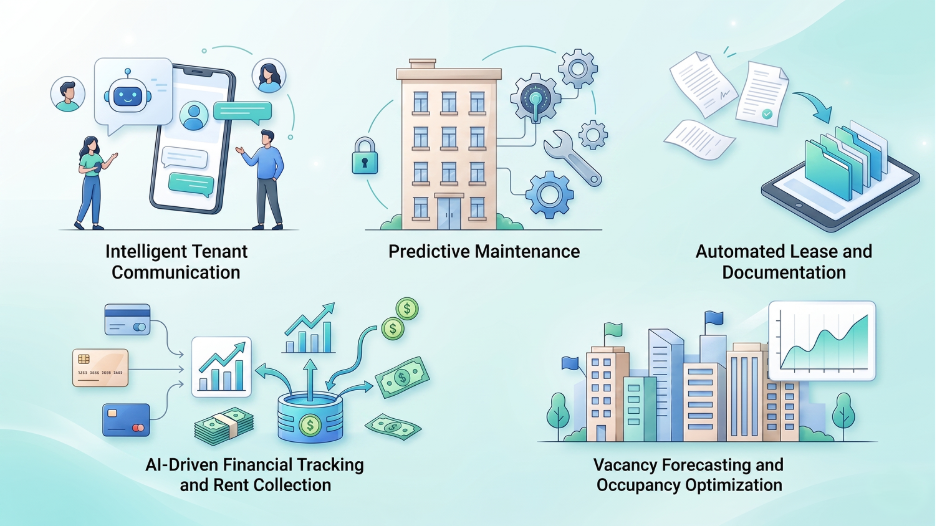
1. Intelligent Tenant Communication
Tenant communication has traditionally been one of the most time-consuming aspects of property management.
Residents expect immediate responses regarding:
- Maintenance requests
- Lease updates
- Payment reminders
- Amenity bookings
- Visitor approvals
- General support questions
Property teams often struggle to manage high communication volumes efficiently.
AI-powered chat systems and virtual assistants are helping solve this issue.
These tools provide instant responses to common tenant requests without requiring manual staff intervention for every interaction. Instead of waiting for office hours, tenants receive faster support around the clock.
This improves tenant satisfaction while reducing workload for property management teams.
AI communication systems also help organize conversation histories, prioritize urgent issues, and automate follow-ups, improving operational consistency across large portfolios.
2. Predictive Maintenance and Smart Building Monitoring
Maintenance remains one of the largest operational expenses in property management.
Traditional maintenance systems usually depend on reactive workflows. Equipment is repaired only after a breakdown, often resulting in emergency costs, tenant dissatisfaction, and operational disruption.
AI changes this approach completely.
Modern property management systems analyze historical repair records, equipment activity, utility usage patterns, and IoT sensor data to predict maintenance requirements before failures occur.
For example:
- HVAC systems showing unusual energy consumption patterns
- Water systems indicating pressure irregularities
- Elevators demonstrating inconsistent operational behavior
- Electrical systems generating abnormal usage spikes
Instead of waiting for costly failures, property managers can schedule preventive maintenance earlier.
This reduces repair expenses, improves equipment lifespan, and minimizes operational disruptions.
According to IBM Predictive Maintenance Research, predictive maintenance strategies significantly improve operational efficiency while lowering unplanned downtime costs.
The same principle is now becoming increasingly important within commercial and residential property operations.
3. Automated Lease and Documentation Management
Lease administration involves large volumes of repetitive work.
Property teams regularly handle:
- Lease creation
- Renewal reminders
- Tenant verification
- Documentation updates
- Payment schedules
- Contract approvals
Manual lease tracking often creates delays and increases the risk of missed deadlines or documentation errors.
AI-powered document systems automate these workflows.
The software automatically tracks lease timelines, generates reminders, organizes documentation, and processes updates based on predefined workflows.
Some advanced platforms also use natural language processing to extract information directly from contracts and legal documents, significantly reducing administrative effort.
This improves operational accuracy while helping property teams manage larger portfolios without increasing staffing requirements.
4. AI-Driven Financial Tracking and Rent Collection
Financial management is another area being transformed through AI features.
Property management software now helps automate:
- Rent reminders
- Invoice generation
- Payment reconciliation
- Expense categorization
- Financial reporting
AI systems can also analyze payment behavior trends and identify potential late-payment risks earlier.
This gives property managers stronger financial visibility and helps improve revenue stability.
Rather than manually compiling reports from multiple spreadsheets, businesses gain centralized financial dashboards with real-time operational insights.
This improves forecasting accuracy and reduces administrative workload for finance teams.
5. Vacancy Forecasting and Occupancy Optimization
Vacancy management directly impacts profitability.
Empty units increase operational losses and reduce overall portfolio performance. Traditional forecasting methods often rely heavily on manual assumptions and historical comparisons.
AI-powered analytics improve this process significantly.
The software evaluates:
- Historical occupancy trends
- Local market activity
- Lease expiration cycles
- Tenant movement patterns
- Seasonal demand behavior
Using these insights, property managers can predict vacancy risks earlier and plan marketing or leasing strategies proactively.
This improves occupancy rates and helps reduce long vacancy periods.
Advanced AI Features Emerging in 2026
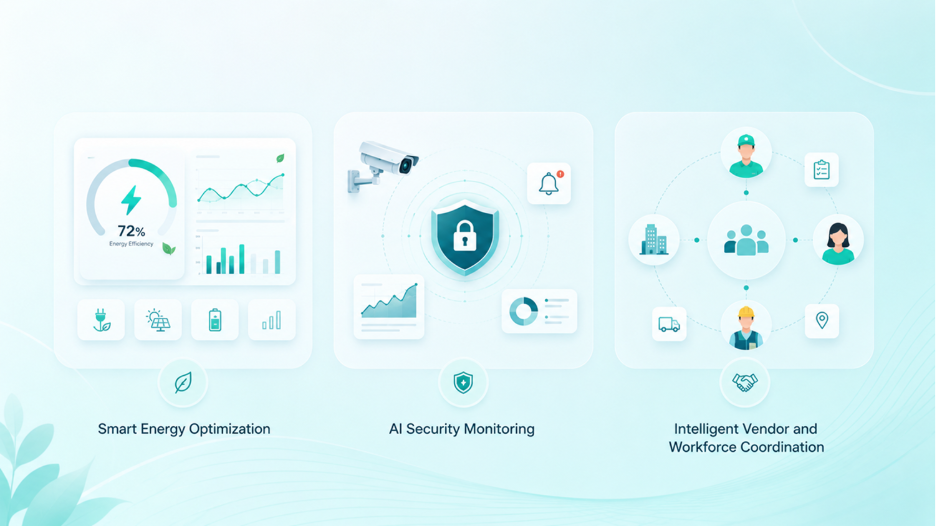
1. Smart Energy Optimization
Energy efficiency is becoming increasingly important across residential and commercial real estate.
AI-powered property systems now continuously monitor energy usage across lighting, heating, cooling, and smart building infrastructure.
Instead of fixed operational schedules, the software adjusts systems dynamically based on:
- Occupancy behavior
- Weather conditions
- Utility consumption patterns
- Building activity levels
This helps reduce unnecessary energy consumption while lowering operational expenses.
Many real estate operators are also using AI-driven sustainability reporting to monitor environmental performance across large portfolios.
2. AI Security Monitoring
Security management is evolving rapidly with the integration of AI.
Modern property platforms use AI-enhanced surveillance systems that can identify suspicious behavior patterns, unauthorized access attempts, and unusual building activity.
Instead of depending entirely on manual security monitoring, AI systems automatically generate alerts when abnormal activity is detected.
This improves response times while strengthening overall building security.
According to Microsoft AI Business Applications, AI-powered operational monitoring is becoming increasingly important for real-time infrastructure management and intelligent automation across industries.
Property technology is increasingly adopting these same capabilities.
3. Intelligent Vendor and Workforce Coordination
Managing vendors, contractors, and maintenance teams across multiple properties can become highly complex.
AI-powered scheduling systems now help automate:
- Vendor assignments
- Maintenance scheduling
- Workforce prioritization
- Resource allocation
- Service coordination
The system analyzes workload distribution, urgency levels, technician availability, and property conditions to improve operational efficiency.
This reduces delays and improves consistency in service response across properties.
Why AI Adoption Is Accelerating in Real Estate
Several industry-wide changes are driving AI adoption within property management software.
First, tenant expectations continue evolving toward faster, digital-first experiences.
Second, property operators are under pressure to reduce costs while managing growing operational complexity.
Third, cloud infrastructure and AI technologies have become more accessible and scalable for real estate businesses of different sizes.
Fourth, the availability of operational data through smart devices and connected systems has increased dramatically.
These factors are making AI implementation more practical and commercially valuable for property management companies.
Challenges of AI Adoption in Property Management
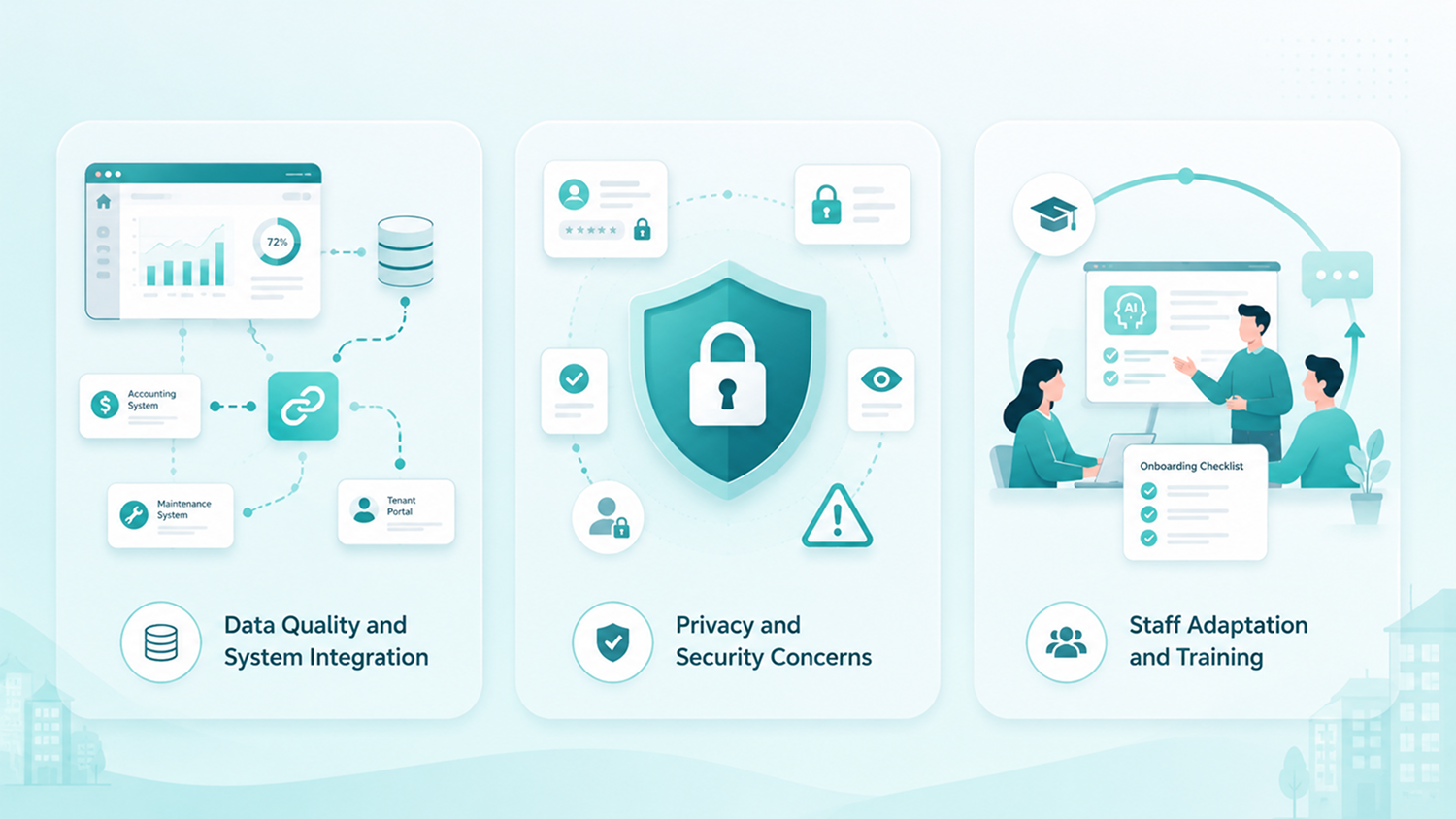
Despite the benefits, AI adoption also comes with challenges.
1. Data Quality and System Integration
AI systems depend heavily on accurate operational data.
Disconnected legacy systems, inconsistent records, and incomplete data can significantly reduce AI performance.
Businesses often need stronger centralized data infrastructure before implementing advanced automation features.
2. Privacy and Security Concerns
Property management systems handle sensitive tenant information, payment data, and operational records.
AI platforms must follow strong security practices, including:
- Data encryption
- Access controls
- Secure cloud architecture
- Compliance monitoring
Protecting operational and tenant data remains a critical priority.
3. Staff Adaptation and Training
Some property teams initially resist automation because of workflow changes.
Successful AI adoption requires proper onboarding, training, and operational alignment to ensure teams understand how to use intelligent systems effectively.
What the Future of AI Property Management Looks Like
AI is expected to become a core operational layer within property management over the next few years.
Future platforms will likely include:
- More autonomous operational workflows
- Stronger predictive decision systems
- AI-driven tenant personalization
- Fully connected smart building ecosystems
- Advanced financial forecasting tools
- Automated compliance monitoring
Property management software will continue evolving from administrative systems into intelligent operational control centers.
Businesses adopting these technologies early will likely gain stronger operational efficiency, improved tenant retention, and better long-term scalability.
How DEVtrust Helps Real Estate Businesses Build AI-Powered Property Platforms
DEVtrust develops scalable property management software solutions designed for modern real estate operations.
Our expertise includes:
- AI-powered workflow automation
- Tenant management systems
- Smart dashboards
- Predictive maintenance tools
- Property analytics platforms
- Cloud-native infrastructure
- Mobile applications
- ERP and third-party integrations
We focus on building systems that improve operational visibility, simplify property workflows, and support long-term business growth.
Real-World Example
A property management company managing residential and commercial properties struggled with delayed maintenance coordination, fragmented communication, and limited operational reporting.
DEVtrust implemented a centralized AI-powered property management platform featuring:
- Automated maintenance workflows
- Tenant communication tools
- Predictive maintenance alerts
- Financial dashboards
- Real-time operational reporting
Results
- 45% reduction in maintenance response delays
- Faster tenant issue resolution
- Improved operational visibility
- Lower manual administrative workload
Conclusion
AI features are fundamentally changing how property management software operates. What was once limited to basic record management is now evolving into intelligent operational infrastructure capable of automation, prediction, and real-time decision support.
As tenant expectations increase and operational complexity continues growing, traditional property management systems are becoming less effective for modern real estate operations.
AI-powered software helps businesses improve efficiency, reduce operational costs, strengthen tenant experiences, and make more informed decisions across residential and commercial portfolios.
The companies investing in intelligent property management systems today are positioning themselves for stronger scalability, better operational control, and long-term competitive advantage in the evolving real estate market.
Ready to Modernize Your Property Management Operations?
DEVtrust helps real estate businesses build scalable AI-powered property management software that automates, enhances operational visibility, and supports smarter decision-making.
Whether you need tenant management systems, predictive maintenance tools, or intelligent property workflows, our team delivers technology solutions built for long-term growth.
Book a consultation with DEVtrust today and start building smarter property operations.
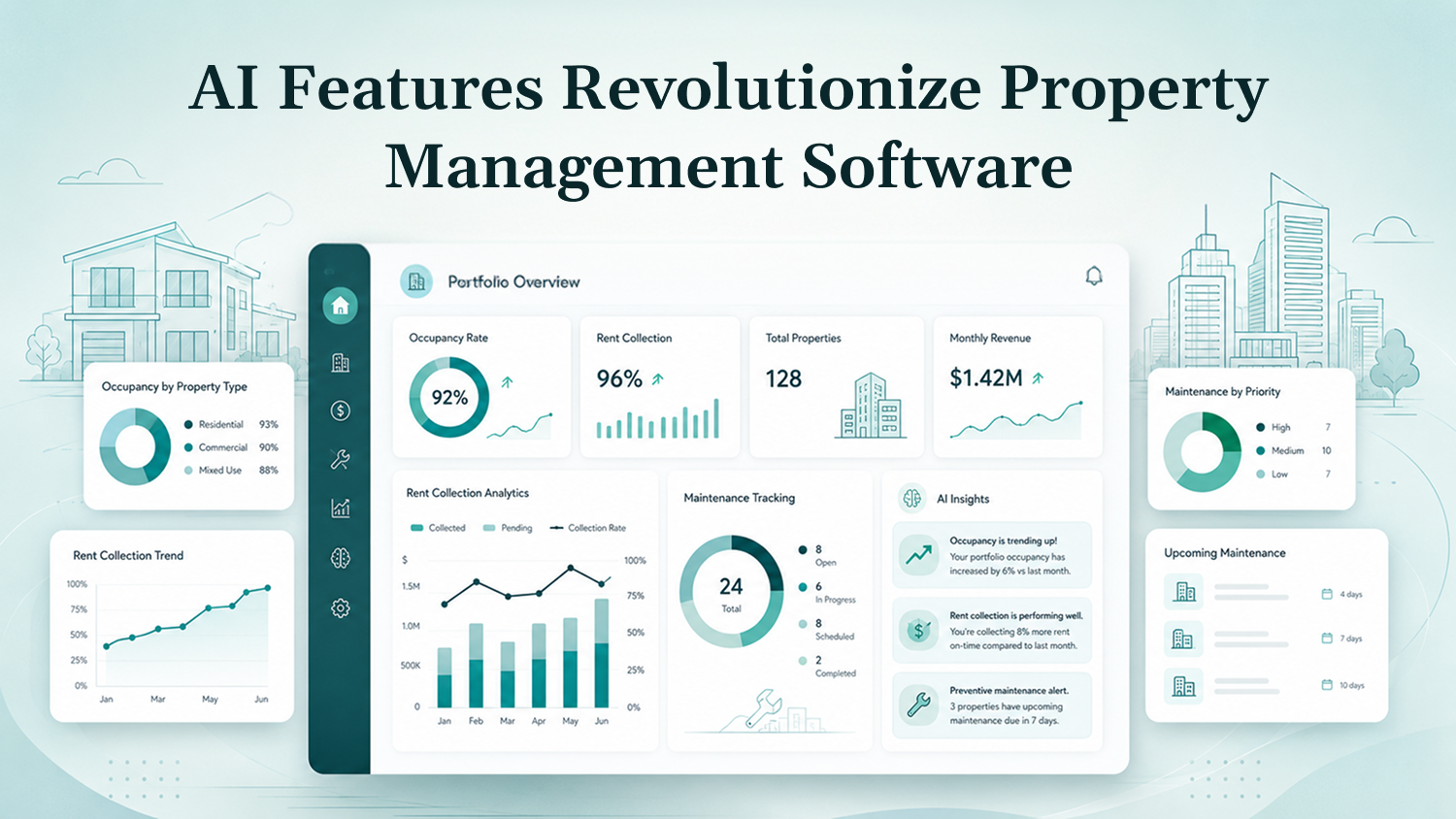
AI Features Revolutionize Property Management Software
AI-powered property management software improves automation, maintenance planning, tenant communication, and operational visibility. Real estate businesses are using intelligent platforms to reduce manual work, improve efficiency, and deliver better tenant experiences in 2026.