

As an engineering leader or product manager, you’re tasked with improving app performance while maintaining a smooth user experience. However, slow load times and poor interactivity are still major obstacles, often leading to frustrated users and missed opportunities.
Research shows that businesses adopting Progressive Web Apps (PWAs) report up to 70% higher engagement and 20% higher conversion rates, thanks to faster load times and improved functionality.
This blog will explore how PWAs can address common challenges and enhance your app’s performance. We will provide a list of the top 7 frameworks and tools to help you make the most of PWA development for your business, boost user engagement, and optimize app speed.
Quick Recap
- PWAs are essential for businesses aiming to deliver fast, engaging, and cross-platform experiences with improved performance and user engagement.
- Some top frameworks for 2026 include React, Angular, Vue.js, Ionic, and Svelte and Lit, each with unique strengths for various business needs.
- Key advantages of PWAs include offline functionality, push notifications, faster load times, and automatic updates, offering seamless user experiences without needing app store installations.
- When choosing a PWA framework, consider performance, scalability, development speed, and integration capabilities with third-party tools to align with your goals and team expertise.
What is a Progressive Web App (PWA)?
A Progressive Web App (PWA) is a modern web development approach that blends the best of both native apps and websites. PWAs use standard web technologies such as HTML, CSS, and JavaScript to deliver an app-like experience that can be accessed directly in a mobile browser.
Unlike native apps, PWAs load faster, function offline, and can be indexed by search engines, making them a powerful solution for businesses aiming for a seamless, cross-platform presence.
Why PWAs Are a Smart Choice for Modern Apps
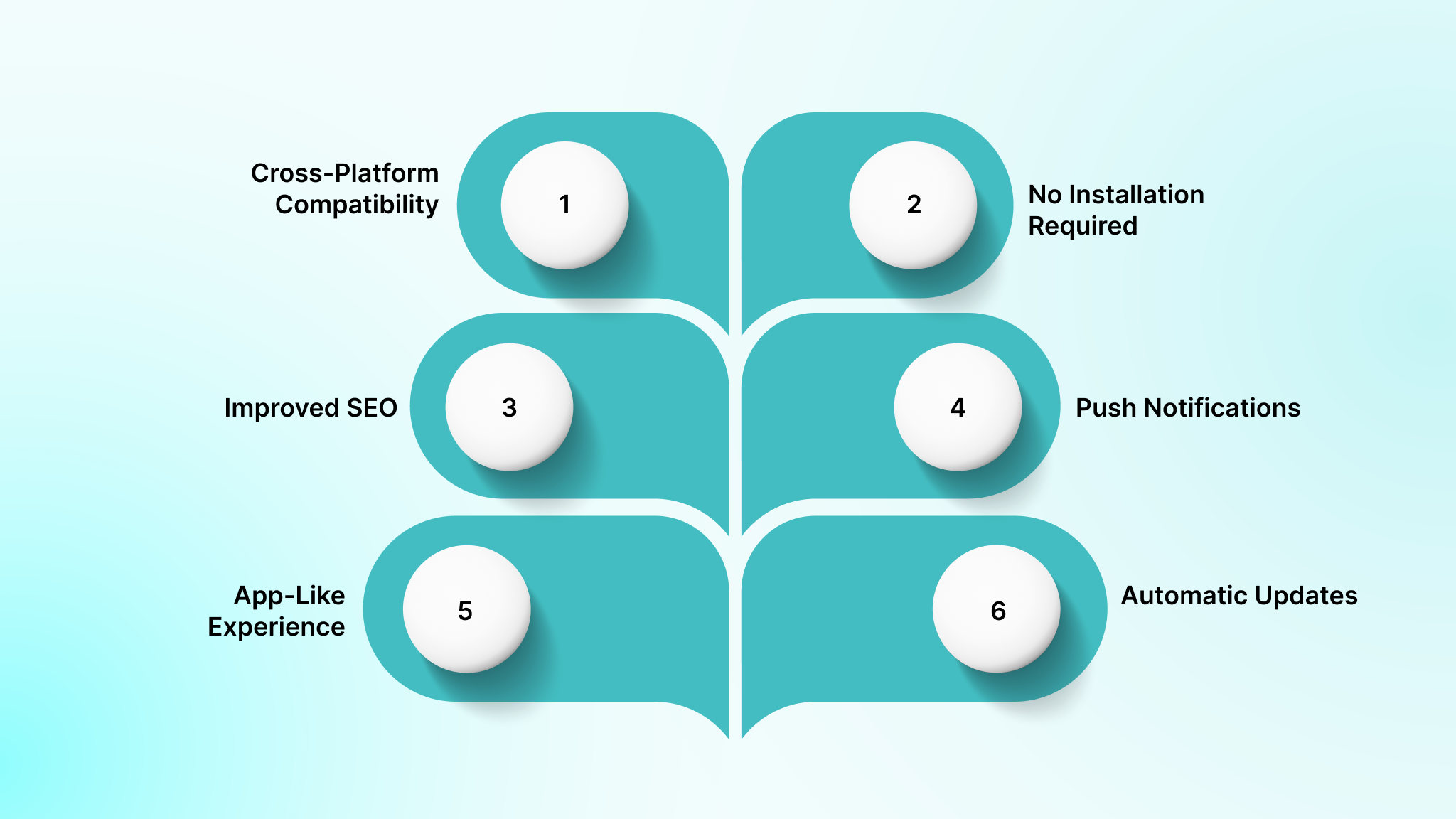
- Cross-Platform Compatibility: PWAs work across all devices, including smartphones, tablets, and desktops, without needing separate versions for different operating systems.
- No Installation Required: Users don’t need to download or install anything. Simply visit the site to use the app-like features.
- Improved SEO: Since PWAs are technically websites, they can benefit from search engine optimization (SEO), improving their search ranking and discoverability.
- Push Notifications: Engage users even when they’re not actively using the app. PWAs can send push notifications to keep users informed and involved.
- App-Like Experience: With a familiar UI/UX, PWAs mimic the smooth, responsive experience of a native app.
- Automatic Updates: PWAs automatically update in the background without requiring manual intervention, ensuring users always have access to the latest features.
A Few Things to Keep in Mind
- Battery Drain: Since PWAs run on web technologies, they can be more power-hungry, leading to faster battery drain on mobile devices than native apps.
- iOS Support: Modern iOS versions (16.4 and above) have improved support for PWAs, including Home Screen apps. However, some features, such as background tasks and certain platform integrations, still work more smoothly on Android.
- Hardware and API Access: PWAs can use many device features, but access is generally narrower than native apps and can vary by operating system. Features like biometric authentication, advanced camera controls, or other hardware-dependent functions may have limitations compared to native apps.While PWAs offer a cost-effective solution for businesses looking to enhance their mobile presence, it’s essential to weigh the pros and cons to determine if they’re the right fit for your project.
Also Read: Web Application Development: A Complete Beginner’s Guide
Now that we understand what a PWA is, let’s look at how to choose the right framework for building one.
How to Choose the Best Framework for Progressive Web Apps
The vast selection of PWA frameworks can quickly lead to decision paralysis. With so many options to sift through, it’s easy to feel overwhelmed. To choose the right framework for your project, consider these essential factors:
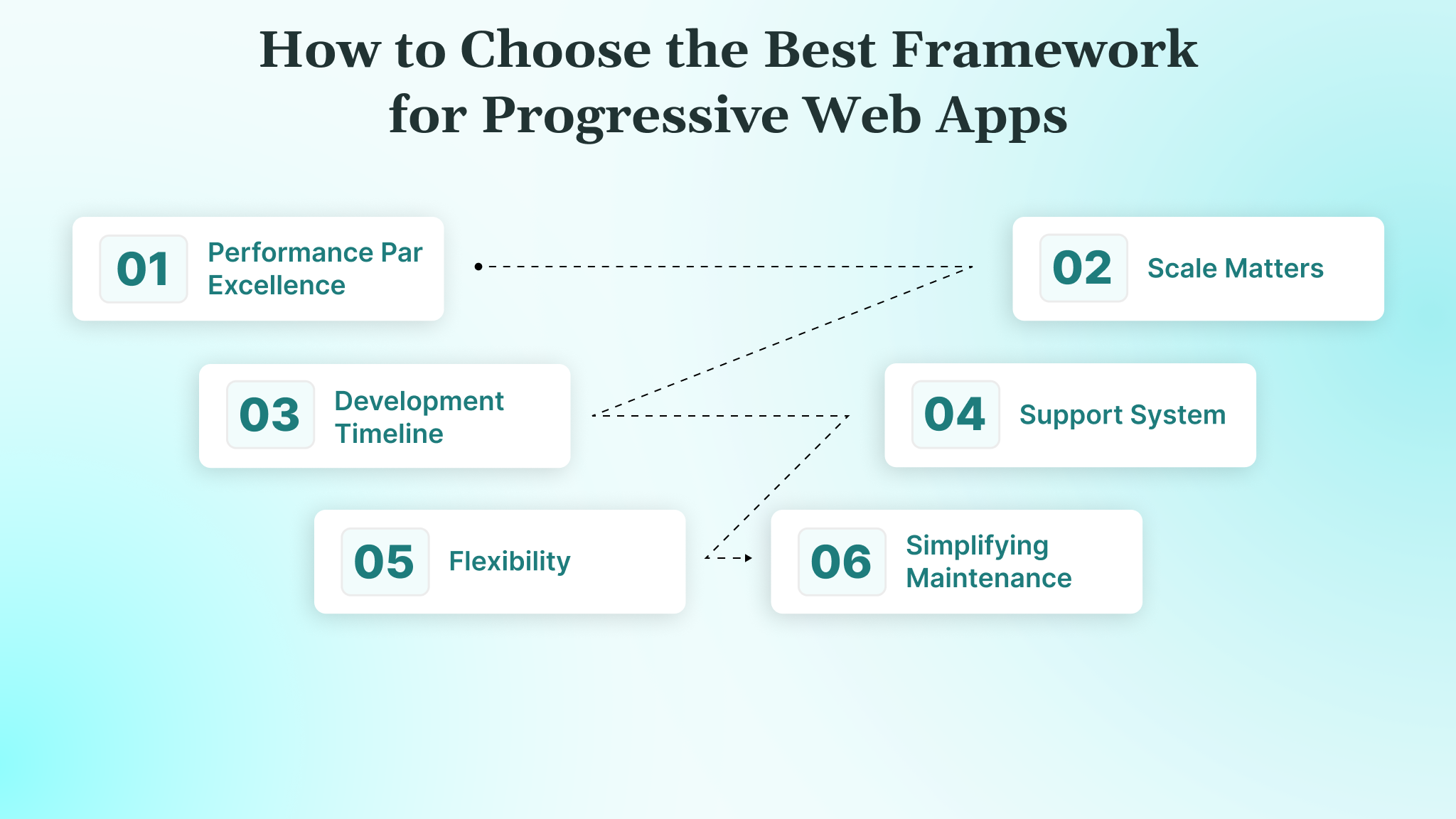
1. Optimized Performance
Prioritize a framework that supports server-side rendering (SSR) for fast load times and a smooth user experience. Keep an eye on the framework’s size, as a heavier framework can slow down your app, undermining the speed you’re aiming for.
2. Scale Matters
For large-scale applications, opt for a feature-rich framework with extensive component libraries. For smaller projects, lighter frameworks are often more suitable, offering agility and efficiency without unnecessary bloat.
3. Development Timeline
Development speed matters, so choose a framework with a learning curve that matches your team’s skill set and project timeline. While some frameworks offer advanced features, simplicity might help you meet deadlines and deliver quality without delays.
4. Support System
Make sure the framework you choose has reliable support channels, such as forums, FAQs, and detailed guides. This ensures quicker problem resolution and minimizes development downtime.
5. Flexibility with Third-Party Tools
Opt for frameworks that integrate seamlessly with popular third-party tools and libraries. This will streamline your development process and enable you to incorporate features such as background sync.
6. Simplifying Maintenance
Choose a framework that supports modular and reusable components. This helps keep your codebase clean, easy to maintain, and simple to scale. A maintainable framework will also ensure new team members can onboard quickly, saving time in the long run.
Choosing the right framework is key to the success of your PWA, and DEVtrust can guide you through this process with our expertise in frameworks like React, Angular, and Vue.js. Whether you’re focused on fast load times, seamless integrations, or maintainable codebases, we ensure that your PWA delivers the best possible user experience, with a framework that suits your project’s scale and timeline.
Also Read: Guide to Outsource Website Development Effectively
With the right criteria in mind, let’s explore the top PWA frameworks and tools that are set to lead in 2026.
Top 7 Progressive Web App Development Frameworks and Tools to Know in 2026
As the demand for faster, more engaging web experiences grows, Progressive Web Apps (PWAs) have become a key solution for businesses. This section will explore the top 7 frameworks and tools that are set to dominate PWA development in 2026, each offering unique strengths to meet your app development needs.
Quick Glance: Top 7 Progressive Web App Development Frameworks and Tools to Know in 2026
| Framework | Best For | Pros | Cons |
| React.js | Building dynamic, high-performance PWAs with fast content updates. | High scalability, Reusable components, Fast rendering, Web & native app deployment. | Requires JSX knowledge, Can be complex for beginners, Flexibility leads to issues. |
| Angular | Building scalable, enterprise-level PWAs with a solid development structure. | Well-defined process, Strong Google support, Angular CLI, TypeScript integration. | Requires TypeScript knowledge, Complex debugging, Frequent updates. |
| Vue.js | Developing lightweight, fast-loading PWAs for quick deployments. | Easy to pick up, Fast rendering, Flexibility for small & large projects. | Community-driven, Lack of corporate backing, Flexibility can lead to misconfigurations. |
| Ionic | Cross-platform, mobile-first apps that need a consistent native app-like experience. | Open-source, Easy for Angular devs, Excellent for maintenance and updates. | Frequent updates may require rework, Performance limitations for heavy tasks. |
| Svelte | Performance-oriented PWAs with a focus on simplicity and rapid development. | Fast runtime performance, Smaller bundle size, Low learning curve. | Limited community support, Smaller ecosystem than React/Angular; some enterprise teams prefer more established governance. |
| Lit | Building reusable, lightweight PWAs and web interfaces using standards-based web components. | Framework-independent, Lightweight footprint, Reusable components, Strong interoperability. | Requires careful CSS handling when used with global UI frameworks. Not a full SPA framework without additional tooling. |
| PWA Builder | Developers looking for a simple, rapid way to convert websites into PWAs. | Easy to use, Quick deployment, Budget-friendly, Excellent for small businesses. | Customization beyond basics is tough, Limited to larger, complex apps. |
1. React.js
Released by Facebook (now Meta) in 2013, ReactJS has become one of the most popular frameworks for building Progressive Web Apps (PWAs). Known for its flexibility, React allows developers to create both single-page and multi-page apps that load and update content seamlessly within a single page.
Key Features:
- Component-Based Architecture: Makes building and maintaining apps easier by allowing developers to reuse components.
- Virtual DOM: React optimizes rendering performance, ensuring a faster and more efficient user experience.
- Integration with Tools: Easily integrates with popular tools and libraries, such as Redux and React Router, enhancing its flexibility.
- Mobile-Style Behavior: Supports responsive design, enabling a seamless experience across various devices.
Pros:
- High scalability and flexibility with the addition of various packages.
- Reusable components for efficient maintenance.
- Can deploy the same code for both web and native apps.
Cons:
- Requires knowledge of JSX, making it harder for beginners to grasp.
- No clearly defined methodology can make implementation tricky.
- Migration from AngularJS is challenging due to JSX’s syntax.
- Greater flexibility may introduce functionality issues as complexity increases.
React’s virtual DOM enhances performance, making it ideal for building PWAs that require dynamic content updates and fast rendering.
Also Read: React vs React Native: Key Differences Explained
2. Angular
Angular, developed by Google, is a powerful framework for building scalable web applications. Recent Angular versions have focused on improving performance and developer experience, including ongoing efforts to reduce reliance on Zone.js and make change detection more predictable.
Key Features:
- CLI (Command Line Interface): Angular’s CLI simplifies the development process, automating many repetitive tasks, improving productivity, and reducing setup time.
- Component-based Architecture: Angular encourages modular development, making code easier to manage and maintain.
- TypeScript Integration: TypeScript support allows for improved type-checking and more robust code.
- Material Design Components: Provides a set of pre-built UI components to help developers create modern, responsive designs.
Pros:
- Angular offers a well-defined process, making it easy to implement.
- Thanks to Angular CLI and TypeScript integration, developers can pick it up faster.
- Backed by Google, Angular ensures reliable updates and community support.
Cons:
- Requires TypeScript knowledge, which can be a barrier.
- Its complex architecture can make debugging more challenging.
- Frequent updates can lead to backward compatibility issues in larger projects.
Angular’s comprehensive features, strong community support, and Google’s backing make it an excellent choice for developers looking to build scalable PWAs.
3. Vue.js
Vue.js is a lightweight, open-source front-end JavaScript framework known for its low learning curve and rapid rendering speed. Its ability to scale and integrate with various packages adds to its appeal, allowing developers to craft dynamic and performant web applications.
Key Features:
- Two-Way Data Binding: Ensures that changes to the UI are reflected in the underlying data model and vice versa.
- Virtual DOM: Boosts rendering speed by minimizing the number of DOM manipulations.
- Advanced CLI: Provides powerful development tools for building and managing projects efficiently.
- CSS Transitions and Reusability: Allows for smooth UI transitions and easy reuse of components.
Pros:
- The straightforward architecture makes it easy for developers, even those new to JavaScript frameworks, to pick up quickly.
- Supports both small-scale projects and large-scale, complex applications.
Cons:
- Vue is primarily driven by the community and lacks the extensive corporate backing that other frameworks have, leading to minimal official support.
- While flexibility is an advantage, it can lead to challenges when misused or misconfigured.
- Despite its popularity, finding Vue developers can be more challenging compared to frameworks like React or Angular.
If you’re looking to build an MVP or lightweight PWA quickly, Vue provides the tools to streamline development. While its flexibility can be a double-edged sword, the power and simplicity it offers make it a strong contender for developers building modern PWAs.
Also Read: Custom Web Application Development Guide and Benefits
4. Ionic
Ionic, an open-source SDK built on Angular and Apache Cordova, was launched in 2013 and has since become a popular framework for building hybrid apps. By using WebView, Ionic allows web pages to run inside a device browser, creating an app-like experience.
Key Features
- Cross-Platform Compatibility: Ionic provides seamless development for both mobile and desktop platforms.
- Comprehensive Component Library: Includes a wide array of pre-built components for both iOS and Android.
- WebView Integration: Allows web pages to appear as native apps in the browser.
- Built on Angular: Leverages Angular’s architecture for developers familiar with the framework.
Pros
- Being open-source, Ionic is free to use, making it an affordable option, especially for small businesses.
- Developers familiar with Angular and web technologies can quickly adapt to Ionic, reducing the learning curve.
- Built-in debugging tools and browser instruments simplify the maintenance and troubleshooting process.
- Offers a large set of plugins for API access with minimal coding.
Cons
- Regular updates to the framework may require developers to rework existing PWAs to align with new changes, which can be time-consuming.
- While effective for hybrid apps, performance may not always match that of fully native applications, especially for resource-intensive tasks.
Ionic stands out due to its open-source nature, ease of use, and cross-platform capabilities. It’s an attractive option for businesses looking to develop cost-effective, responsive, and scalable PWAs.
5. Svelte
Svelte is a modern JavaScript framework for building reactive, high-performance web apps. Unlike frameworks using a virtual DOM, Svelte compiles components into vanilla JavaScript at build time, reducing runtime overhead and bundle size.
Key Features
- Minimalistic and fast: Svelte generates small code bundles that load quickly.
- Reactive programming model: It’s designed to be reactive, meaning updates to the UI happen automatically when the state changes.
- Simplified syntax: Svelte’s syntax is easy to learn, even for developers without deep JavaScript knowledge.
- Built-in PWA support: The starter template includes a PWA package, providing out-of-the-box support for service workers and metadata for social sharing.
Pros
- Faster runtime performance due to its compile-time approach.
- Smaller bundle size results in better performance and quicker load times.
- Low learning curve for developers familiar with basic JavaScript, thanks to its simple syntax.
- Improved development speed with hot module reloading, speeding up the development cycle.
Cons
- Limited community support due to its relatively new presence in the market.
- Lack of comprehensive documentation compared to more established frameworks like React and Angular.
- Smaller ecosystem than React/Angular; some enterprise teams may prefer a more established governance.
Svelte stands out for its performance and simplicity. For smaller projects or those requiring rapid development, Svelte provides a compelling option that doesn’t sacrifice quality.
6. Lit
Lit is a modern library for building fast, lightweight web components that work across any framework or in plain HTML. Its components are reusable and interoperable, making it easy to share UI elements across multiple apps and progressively enhance websites without being tied to a specific framework.
Key Features
- Component-Based Architecture: Every Lit component is a standard web component, ensuring seamless integration across platforms and frameworks.
- Reactive Templates: Declarative templates and reactive properties automatically update the UI when data changes, minimizing manual DOM manipulation.
- Scoped Styles: CSS is scoped to each component, preventing style conflicts and keeping designs consistent.
- Lightweight and Fast: At around 5 KB, Lit has a minimal footprint and only updates dynamic parts of the UI, providing high performance.
Pros
- Framework-independent, allowing components to be reused in various apps.
- Simplifies maintainability and reduces boilerplate code.
- Excellent for progressively enhancing static sites or building modular design systems.
Cons
- Requires careful CSS management, especially when integrating with UI frameworks like Bootstrap.
- Not a full SPA framework; complex single-page app architecture may require additional tools.
Lit enables developers to create reusable, interoperable UI elements that can be shared across multiple sites and apps, making it ideal for design systems and progressive enhancement.
7. PWA Builder
PWA Builder, created by Microsoft, is an open-source tool designed to simplify the process of converting websites into Progressive Web Apps (PWAs). Known for its ease of use and rapid deployment, PWA Builder enables developers, including those with limited coding experience, to create responsive PWAs quickly.
Key Features:
- Automatic Conversion: PWA Builder can convert websites into PWAs with minimal input, enabling faster turnaround times.
- Cross-Platform Support: It works across multiple devices and platforms, including Android and iOS, ensuring wide accessibility.
- Vue.js Integration: Built with Vue.js, it provides a modern, user-friendly development environment for building PWAs.
- Templates & Tools: PWA Builder provides templates with pre-defined layouts and essential PWA components, streamlining the development process.
Pros:
- PWA Builder is ideal for developers at any level of experience. The process is straightforward, requiring little to no coding to get started.
- Since it’s open source and automated, it’s a budget-friendly solution for businesses that need a simple PWA.
- With ready-to-use templates and a guided process, PWAs can be deployed quickly, helping businesses get to market faster.
Cons:
- Due to the automated process, customizing the app beyond basic features can be challenging.
- Larger, more complex web applications may not benefit as much from the framework’s simplicity, as specialized requirements could be harder to implement.
Developers are drawn to PWA Builder for its simplicity, speed, and accessibility, especially for smaller businesses or teams looking to launch a mobile-friendly, cross-platform app quickly.
Understanding the strengths of these top PWA frameworks and tools helps you make an informed decision that aligns with your project’s goals.
At DEVtrust, we specialize in using the most effective and modern frameworks to build custom Progressive Web Apps that deliver fast, reliable, and engaging user experiences. We use React, Angular, Vue.js, and Ionic to create scalable, high-performance PWAs tailored to your specific requirements.
As PWAs continue to develop, it’s important to stay informed about the latest trends and frameworks shaping the future of mobile web development.
What Does the Future Hold for Progressive Web Apps (PWAs)?
The future of Progressive Web Apps looks very promising as businesses increasingly recognize their value in delivering fast, engaging mobile experiences. The next generation of PWAs will focus on:
- Enhanced API support for consistently accessing device capabilities across platforms.
- Improved installation experiences that make apps feel native without the friction of app store downloads.
- More predictable platform parity so apps behave consistently on iOS, Android, and desktop environments.
PWAs are becoming an essential part of mobile-first strategies, offering businesses a competitive edge in engagement, conversions, and overall customer satisfaction.
Power Business-Ready PWAs with DEVtrust
At DEVtrust, we understand the critical role Progressive Web Apps (PWAs) play in creating fast, scalable, and engaging digital experiences. We specialize in building custom PWA solutions that help businesses drive user engagement, improve conversions, and enhance overall customer satisfaction.
Here’s how we can help you utilize the full potential of PWAs:
- Full-Stack Development Expertise: We build PWAs using leading frameworks like React, Angular, and Vue.js, tailored to your business needs, ensuring a seamless and scalable experience.
- Cloud-Based Architecture: We use AWS, Azure, and Google Cloud to deliver scalable, high-performance PWAs that grow with your business, ensuring reliability and fast load times.
- API Integrations: We integrate tools like Stripe, Twilio, and Firebase to add essential PWA features such as real-time updates and secure payment processing.
- Smooth User Experience: Our team ensures seamless installations and app-like experiences for your users, improving retention and engagement without requiring app store downloads.
- Continuous Deployment & DevOps: Using CI/CD pipelines, we automate deployments and updates, keeping your PWA up to date with minimal downtime and maximum efficiency.
With DEVtrust, organizations gain a trusted partner for building scalable, high-performance PWAs aligned with real business goals.
Conclusion
Progressive Web Apps continue to evolve as a practical, future-ready approach for delivering fast, reliable, and engaging digital experiences across devices.
With ongoing improvements in browser support, performance optimizations, and platform capabilities, PWAs are no longer just a cost-saving alternative to native apps but a strategic choice for businesses prioritizing reach, scalability, and user experience.
At DEVtrust, our team focuses on building well-architected, production-ready PWAs that align with business goals, utilize modern frameworks, and maintain long-term performance and maintainability. Reach out to us today and take the first step toward building a fast, reliable, and engaging mobile experience for your customers.

Frequestly Asked Questions
Related Articles


Web Development
Healthcare Web Development: Comprehensive Guide for 2025

Web Development