


Mobile usage is rising at an incredible pace, with global smartphone users expected to exceed 7.3 billion by 2025. As people spend more time on their phones, businesses are investing in custom apps to stay relevant and deliver better experiences. Even major companies like Google, Amazon and Meta turn to offshore app development to keep costs under control and speed up delivery without overloading their internal teams.
This model is no longer limited to enterprise giants. Startups and growing businesses also depend on offshore partners for faster team onboarding, access to specialized skills and predictable delivery. And with most users going online primarily through mobile devices, having a dependable and user-friendly app has become essential.
This blog explores the key advantages of offshore app development, the practices that make it successful and how to choose the right partner for your next project.
Key Takeaways
- Offshore app development helps businesses build high-quality apps faster and at lower cost by accessing skilled global talent.
- Success depends on clear requirements, strong communication, agile workflows and solid QA, especially for mobile projects.
- Choosing the right partner means evaluating experience, technical depth, security standards, pricing clarity and post-launch support.
- DEVtrust offers full-cycle offshore development, skilled engineering teams and reliable delivery to help you launch and scale your app confidently.
What Is Offshore App Development?
Offshore app development is the practice of outsourcing mobile or software projects to teams based in another country. It gives businesses a cost-effective way to build high-quality applications by tapping into a wider pool of global talent rather than relying solely on local hiring.
Offshore teams usually manage the entire development lifecycle, including design, coding, testing, deployment and ongoing support. They work closely with your internal team so the final product meets both technical expectations and business goals.
Many U.S. companies collaborate with teams in regions like India or Eastern Europe because these markets offer strong engineering expertise at competitive rates. When communication is well structured, time zone differences can also help speed up delivery by keeping work moving beyond local business hours.
This model works particularly well for projects that need specialized skills, faster scaling or continuous iteration. It may be less ideal for work that requires heavy on-site involvement or strict geographic control.
But, why are so many companies choosing offshore development and what makes it such a compelling option today? Let’s find out.
Why Offshore App Development Is Gaining Popularity
Offshore app development has become a go-to strategy for companies that need strong engineering talent, predictable development costs and faster delivery. U.S. teams can keep product ownership close while offshore developers handle design, engineering, testing and ongoing support. This setup works especially well for mobile projects with tight timelines or complex needs, including backend systems, cloud integration, and AI-driven features.
The market itself is expanding quickly. Offshore software development is expected to grow from $122 billion in 2024 to $283 billion by 2031, driven by the rising demand for faster and more affordable digital solutions. Deloitte’s 2023 survey also shows that cost reduction remains the leading reason companies choose offshore development at 70%, followed by access to specialized talent at 65%
Key Advantages of Offshore App Development
Here are the key advantages behind this growing shift:
- Lower Development and Maintenance Costs: Local hiring for senior mobile and backend engineers can quickly push budgets into the six figures per role per year. Offshore teams in regions like India or Eastern Europe give you access to mid–senior engineers at a fraction of the cost, often in the same time zone as your product team.
After launch, you can keep a smaller offshore squad to handle OS upgrades, security patches, and feature tweaks, rather than maintaining a full in-house development department. - Access to Global Talent: Modern apps often need niche skills such as streaming architectures, payment gateway integrations, AI-based recommendations, or domain-heavy capabilities like logistics routing and KYC workflows.
Offshore partners maintain benches of specialists across stacks like React/Angular for front-end, .NET/Node.js/Python for APIs and microservices, and native or cross-platform mobile frameworks. You can assemble the right mix of skills for your app without trying to hire each role locally. - Faster Time-to-Launch: Most offshore companies have established teams ready to begin immediately, helping you avoid slow hiring cycles and reach the market sooner.
- Continuous Progress Across Time Zones: With a U.S.-based product owner and an offshore engineering team, you effectively run a 16–20 hour workday. User feedback and priorities are captured during U.S. hours, then turned into backlog items and implemented overnight by the offshore team.
The next morning, your team reviews new builds, adds comments and unblocks the next sprint, keeping releases moving without long idle gaps. - Stronger Risk Management: Mature offshore teams build redundancy into delivery. They mirror code to secure repositories, document environments using Infrastructure as Code, maintain backup engineers for critical modules and run projects through defined stages (discovery, architecture, implementation, QA, UAT, release). If one engineer becomes unavailable, another can pick up the work without putting your release date at risk.
- Easy Scalability: Offshore engagement models allow you to scale your team up or down quickly based on project needs, without affecting delivery.
- Exposure to Global Best Practices: Working with international teams introduces new frameworks, development approaches and problem-solving styles, often leading to stronger technical decisions.
- Improved Business Focus: With development handled offshore, your in-house team can concentrate on strategy, customer needs and long-term growth.
- Strong Security and Compliance Standards: Reputable offshore partners enforce secure coding practices (e.g., OWASP guidelines), use hardened CI/CD pipelines, restrict access to production data and align with frameworks such as ISO 27001, GDPR or HIPAA where required.
They also standardize basics such as VPN-only access, role-based permissions and encrypted data stores so your app architecture can pass vendor risk assessments and security reviews more easily.
These advantages make offshore development appealing, but achieving them requires the right structure and a clear plan. Let’s look at the practices that matter most.
Best Practices for Successful Offshore App Development
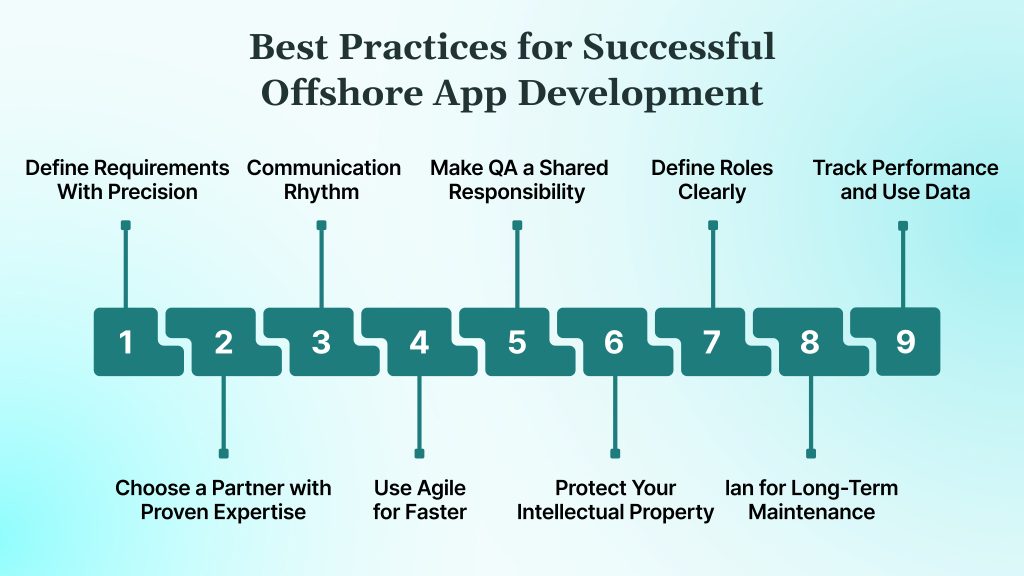
Successful offshore app development depends on clarity, structure and steady communication. These practices help you stay aligned, avoid delays and manage your project with confidence.
1. Define Requirements With Precision
- Start with a clear picture of what you want to build. Define:
- Target platforms: iOS, Android, web, or cross-platform (e.g., Flutter/React Native).
- Core flows: sign-up, onboarding, payments, search, notifications, admin dashboards.
- Technical and compliance needs: third-party APIs, payment gateways, KYC/AML, HIPAA/GDPR, SOC 2 readiness.
- Performance expectations: startup time, response times, peak concurrent users, uptime SLAs.
- Industry constraints: banking approvals, logistics SLAs, healthcare privacy rules.The more concrete these inputs are, the easier it is for an offshore team to design the right architecture from day one.
2. Choose a Partner with Proven Expertise
Review a partner’s case studies, technical capabilities and client feedback. Look for strengths in:
- Mobile and web app development
- Cloud and backend systems
- AI or automation
- Long-term client relationships
- Ability to scale teams quickly
Experience with U.S. clients is an added advantage. Partners like DEVtrust already follow structured communication, agile delivery and a strong QA process, which helps keep projects predictable and aligned.
3. Build a Structured Communication Rhythm
- Consistent communication is essential when working across time zones. A reliable setup usually includes:
- Daily or twice-weekly standups focused on blockers and next steps, not long status monologues.
- Weekly sprint reviews and demos using tools like Jira and Zoom so you see working builds regularly.
- Shared documentation spaces (Confluence, Notion, Google Docs) for specs, API contracts and test cases.
- 2–3 hours of overlap between your day and the offshore team for decisions and clarifications.
- Named escalation owners on both sides (e.g., product owner + engineering lead) to handle urgent issues.
4. Use Agile for Faster, Predictable Delivery
Agile works well for offshore development because it breaks work into manageable cycles. It helps you:
- Review progress frequently
- Adjust priorities early
- Spot blockers quickly
- Improve quality through continuous feedback
Short sprints also make performance measurable and transparent.
5. Make QA a Shared Responsibility
Quality should be part of every stage of development, not just a final testing phase. A strong QA setup for offshore app projects typically includes:
- Automated unit and integration tests run in CI on every merge.
- Manual exploratory testing across key user journeys and edge cases.
- Device and browser matrix coverage for the platforms you support.
- Performance and security checks (API response times, basic penetration checks, dependency scanning).
- Peer code reviews and enforced pull-request workflows so no code reaches production unreviewed.
- Versioned documentation for APIs and features, so future releases don’t accidentally break existing behavior.
6. Protect Your Intellectual Property
Security should be a priority from the start. Put the right safeguards in place, including:
- NDAs and clear IP clauses that state all code, designs and documentation belong to your company.
- Data-handling policies that restrict real production data to your environment and use anonymized datasets for testing.
- Least-privilege access controls for source code, staging and production systems, with all changes traced to named users.
- Repositories under your control (e.g., GitHub, GitLab, Azure DevOps), where you grant and revoke access instead of the vendor owning all repositories.
These measures protect your product and reduce legal or security risks. Make sure compliance requirements such as GDPR or HIPAA are properly documented, as weak protection can lead to costly breaches.
7. Define Roles Clearly
Both teams should know exactly who handles planning, development, testing, approvals and deployment. Clear ownership prevents confusion and speeds up decision-making.
8. Plan for Long-Term Maintenance and Support
Mobile apps require ongoing updates due to OS changes, device updates and evolving user expectations. Choose a partner that offers:
- SLA-based maintenance with clear response and resolution times for bugs and outages.
- Release management support for App Store and Play Store submissions, including handling rejections.
- Monitoring and alerting for crashes, latency and API failures using tools like Firebase Crashlytics or similar.
- Flexible team sizing so you can ramp up for major releases and ramp down during quieter phases without losing continuity.
9. Track Performance and Use Data
Strong offshore partners provide visibility into both engineering and product performance. Useful signals include:
- Sprint burndown and velocity to see whether the team is delivering at a stable pace.
- Defect rates and severity per release, tracked from QA through production.
- User behavior metrics such as retention, funnel drop-offs and time spent in key flows.
- Feature adoption and experiment results so you know which releases actually move business metrics.
- Deployment quality: percentage of successful releases, rollback frequency and mean time to recover from incidents.
What Makes Mobile Development Offshore Different
Mobile development comes with challenges that become even more important when handled offshore. Mobile apps must perform well across platforms, devices and frequent OS updates, which requires careful planning and thorough testing.
1. Platform and Device Variety
Mobile apps have to behave consistently across iOS and Android, different OS versions, screen sizes, chipsets and network conditions. Offshore teams typically maintain a device matrix (e.g., latest iPhones, mid-range Android devices, older models still in use) and combine real-device testing with cloud-based testing platforms to catch layout issues, crashes and performance bottlenecks early.
2. Frequent OS Updates
Apple and Google roll out regular OS updates and policy changes that can break permissions, push notifications, tracking or payment flows. Experienced offshore teams track beta releases, test on pre-release OS versions and schedule compatibility sprints so your app is ready before users upgrade their devices.
3. Higher UX Expectations
Mobile users expect fast, intuitive experiences. Offshore teams with mobile expertise put extra effort into UI and UX testing to ensure the app feels smooth and consistent across devices.
4. The Need for Real-Device Testing
Emulators are useful for early development, but they hide issues like low-memory behavior, thermal throttling, camera and sensor quirks or real-world network drops. Strong offshore partners combine emulators with physical device labs or cloud testing services to validate performance on the same types of devices your users actually hold in their hands.
5. Faster Delivery with Cross-Platform Tools
Frameworks like Flutter and React Native allow teams to build for both iOS and Android from a single codebase. This shortens development time and simplifies maintenance.
6. App Store and Play Store Requirements
Each store has its own publishing rules. Offshore teams familiar with these guidelines help ensure smooth approvals and compliance with privacy and security expectations.
DEVtrust’s mobile teams work with both native and cross-platform frameworks and test across a wide range of real devices to keep apps stable and user-friendly.
As offshore development becomes more common across industries, it’s also changing in meaningful ways. Understanding these shifts can help you plan better for the long term.
Emerging Trends in Offshore Mobile App Development
Offshore mobile app development continues to grow as businesses demand faster delivery, broader expertise and flexible collaboration models. Several emerging trends are shaping how offshore teams build the next generation of mobile apps.
- Remote Work Becomes Standard: Offshore teams now operate seamlessly in remote environments, providing around-the-clock development support across multiple time zones.
- Greater Use of AI and Automation: AI-assisted code completion, test generation and log analysis are helping offshore teams ship more reliable releases in less time. For example, AI tools can suggest test cases for critical flows, highlight risky code changes in pull requests, and surface patterns in crash logs, allowing engineers to focus on resolving the highest-impact issues first.
- Expansion of Cross-Platform Development: Frameworks like Flutter and React Native are reducing costs and enabling faster deployment across both iOS and Android, making them a popular choice for offshore teams.
- Stronger Cybersecurity Practices: More offshore vendors are investing in certifications such as ISO and SOC 2, strengthening data protection and meeting global compliance needs.
- Rise of IoT and Wearable Ecosystems: Offshore developers are increasingly building connected solutions involving sensors, devices and wearables, giving businesses new ways to engage users.
- Blockchain for Secure Digital Experiences: Blockchain is being used to create more secure transactions, improve identity management and support decentralized app features.
These shifts reveal how quickly the offshore model is advancing, but strong results still depend on choosing the right partner.
How to Choose the Right Offshore Development Partner
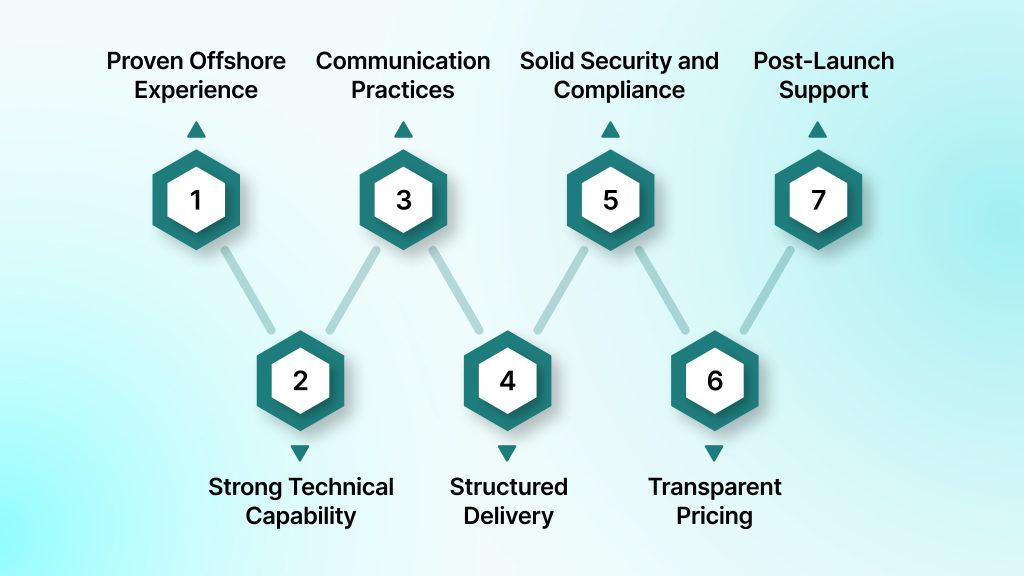
Choosing the right offshore partner is essential for building a dependable, high-quality application. These factors will help you evaluate a team effectively.
- Proven Offshore Experience: Look for companies with several years of offshore delivery experience. They should understand time-zone coordination, remote collaboration and the expectations of U.S. clients.
- Strong Technical Capability: Review their portfolio for expertise in mobile development, backend systems, cloud infrastructure and the tech stack your project requires, whether that is React Native, .NET Core, Kotlin, Swift or AI-driven features.
- Clear Communication Practices: Assess how quickly they respond, how they use collaboration tools and whether they offer direct access to project leads. Reliable communication prevents delays and misunderstandings.
- Structured Delivery Framework: Confirm they follow Agile or Scrum with defined sprints, demos and planning cycles. A disciplined process keeps work transparent and predictable.
- Solid Security and Compliance: Ensure they follow strong data protection practices, secure coding standards and compliance frameworks such as ISO, GDPR or HIPAA. NDAs and clear IP ownership terms should be standard.
- Transparent Pricing: Choose partners who provide clear estimates, detailed scopes and inclusive pricing that covers essentials such as QA, deployments and bug fixes.
- Post-Launch Support: Look for teams that provide ongoing maintenance, updates and monitoring so your app remains stable and secure after release.
If you are considering offshore development, DEVtrust offers a clear and dependable approach backed by skilled engineering teams and a structured delivery model.
How DEVtrust Supports Your Offshore App Development Needs
DEVtrust helps businesses build reliable digital products by combining offshore engineering teams with clear communication and a structured delivery model. Whether you’re shipping a new mobile app, modernizing a backend platform or adding AI-driven features, DEVtrust stays involved from early discovery through post-launch support.
- Full Development Support: DEVtrust covers product discovery, UX/UI, architecture design, development, testing, CI/CD setup and deployment. Teams work across native iOS/Android and modern frontend and backend frameworks to keep the entire stack aligned.
- Skilled Engineering Team: Engineers bring hands-on experience with microservices, event-driven architectures, API design, third-party integrations (payments, logistics, identity) and cloud platforms. This makes them a fit for complex, integration-heavy apps rather than just basic CRUD builds.
- Dedicated Team Model: You get a consistent squad of developers, QA engineers and a delivery lead who focus only on your roadmap, learn your domain and stay with you across multiple releases.
- Easy Collaboration with U.S. Teams: DEVtrust uses sprint-based delivery, shared tools for tracking work and overlapping hours with U.S. time zones so product owners can review builds, reprioritize and unblock work without delays.
- Strong Quality and Security: The team follows secure coding practices, peer review for every pull request and structured test cycles across staging and pre-production environments before releasing to the app stores or live users.
- Flexible and Scalable: You can start with a small core team to validate an MVP, then scale up as your product gains traction, without having to rehire or re-onboard from scratch.
DEVtrust has delivered results across multiple industries, including building a modern rate management system for Draydex that improved operational efficiency and strengthened their logistics workflows. Check out the case studies to know more.
Conclusion
Offshore app development gives businesses a practical way to move faster, control costs and access the talent needed to build strong digital products. When you set clear requirements, communicate consistently and choose the right partner like DEVtrust , offshore teams can deliver high-quality results while your internal team stays focused on the work that matters most.
If you’re planning a new mobile app or need to stabilize and extend an existing one, the offshore model lets you assemble the right mix of skills without waiting months for local hires.
Ready to build with confidence? DEVtrust can support your project end-to-end with experienced offshore engineers, transparent processes and reliable delivery.
Get in touch with DEVtrust to discuss your roadmap and see how an offshore team can support your next app from idea to launch and beyond.
Frequestly Asked Questions
Related Articles
Mobile App Development
A Step-by-Step Framework for Business Mobile App Development

Mobile App Development
Machine Learning App Development: A Comprehensive Guide
Mobile App Development