

Engineering teams often reach a point where delivery slows due to gaps in architecture, limited DevOps capacity, or growing pressure to support multi-tenant workloads. These issues appear as unstable releases, inconsistent API behavior, rising cloud costs, and integration failures. With the SaaS development services market projected to attain $500 billion by 2033, many leadership teams are assessing whether outsourcing SaaS development can help stabilize their platform and improve release predictability.
For CTOs, Heads of Product, and founders building complex SaaS systems, the question is not simply about cost. The focus is on whether outsourcing SaaS development can strengthen service boundaries, support dependable CI/CD pipelines, improve infrastructure consistency, and help the platform scale without extensive internal hiring.
This blog covers the signs of underlying engineering challenges, what outsourcing involves, the measurable benefits, risks that matter, and how a structured outsourcing model supports long-term product growth.
Key Takeaways
- Outsourcing SaaS development supports faster delivery by adding engineering capacity for architecture, cloud setup, API development, and DevOps without long internal hiring cycles.
- Strong results depend on structured discovery, clear service boundaries, tenant-aware design, stable CI and CD pipelines, and consistent environment management.
- Leaders should evaluate partners based on their ability to handle multi-tenant workloads, controlled releases, secure integrations, compliance workflows, and long-term platform stability.
- DEVtrust provides architecture planning, service development, cloud provisioning, testing, and performance monitoring to help SaaS teams build reliable, scalable products.
Signs Your Business Is Struggling With SaaS Development
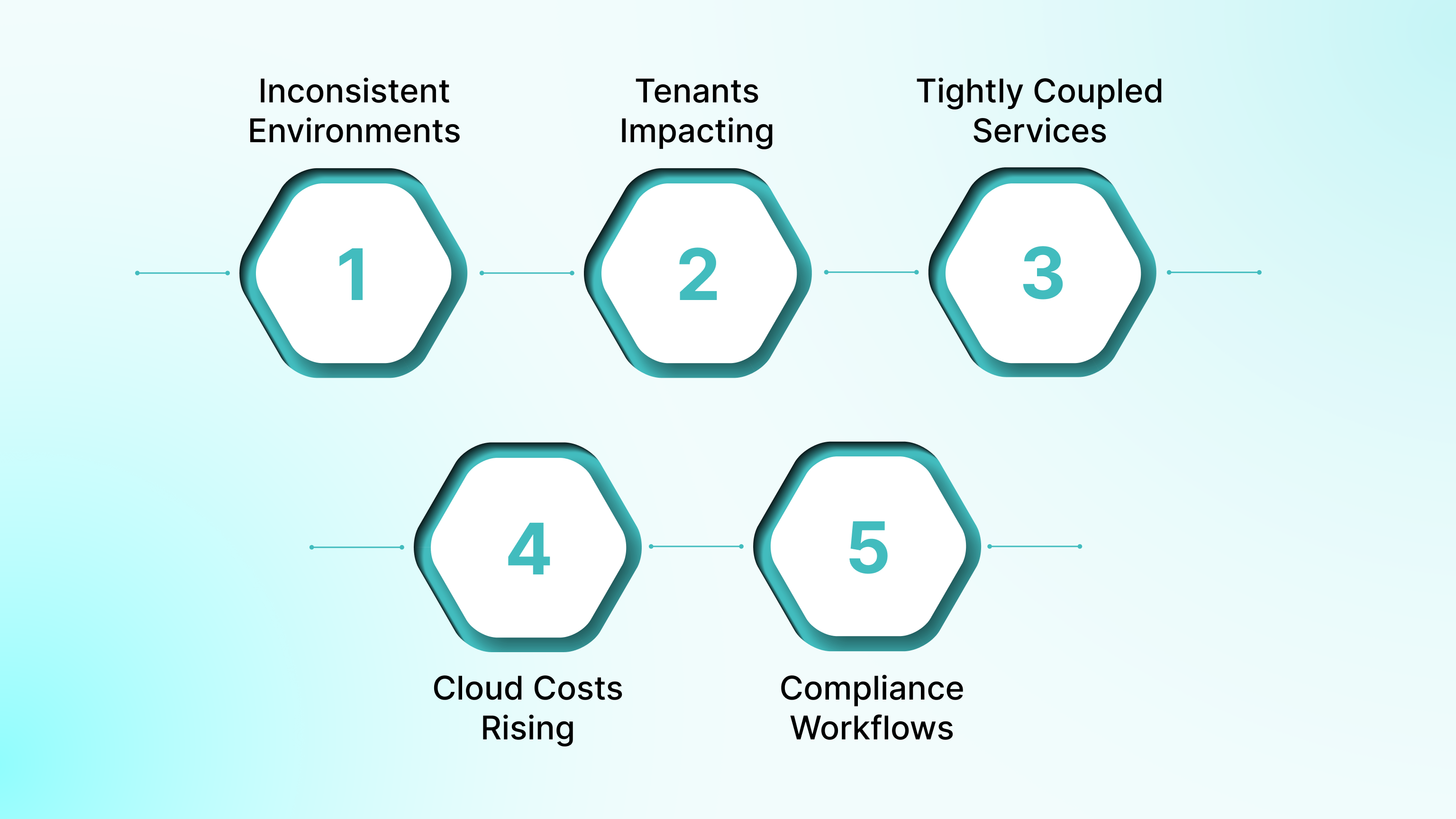
SaaS failure signals appear first inside engineering workflows, not user reviews. These issues reveal gaps in architecture, DevOps maturity, cloud configuration, and data flows. When they surface repeatedly, it becomes clear that the product cannot scale without stronger technical depth or external support.
- Unstable CI, CD, and Inconsistent Environments: Builds pass locally but fail in staging or production due to missing automated tests, unversioned configs, inconsistent environment variables, or manual deployment steps that introduce errors.
- Tenants Impacting One Another During Peak Usage: Heavy queries or batch jobs from a single customer slow down others, indicating weak tenant isolation, missing row-level security, poorly scoped caching, or limited horizontal scaling.
- Tightly Coupled Services With Fragile Dependencies: A single service outage cascades across the system because there are no queues, fallback logic, circuit breakers, or asynchronous processing patterns to absorb failures.
- Cloud Costs Rising Without Technical Justification: Billing spikes come from idle containers, misconfigured autoscaling, oversized DB instances, missing TTL on logs, or untracked egress, revealing weak cloud governance and cost controls.
- Integrations and Compliance Workflows Failing Under Load: Third-party calls break without retry logic or dead-letter queues, while SOC 2 or HIPAA checks fail due to missing audit logs, weak access control, unlogged admin actions, or absent MFA.
These issues reveal where internal capacity reaches its limits. The next step is understanding what outsourcing SaaS development actually covers and how external teams address these gaps.
For teams refining their engineering roadmap, a detailed breakdown of each delivery stage is covered in the How to Develop a Cloud Application Step-By-Step Guide.
What Outsourcing SaaS Development Actually Involves
Outsourcing SaaS development covers the engineering foundations required to run a scalable product. This includes architecture planning, cloud setup, DevOps pipelines, service development, QA, security controls, and long-term maintenance.
- Designing Scalable Architecture and Tenant Isolation: External teams define service boundaries, API contracts, data models, and tenant isolation rules, selecting patterns such as row-level security, schema-per-tenant, or service separation. They map event flows and plan asynchronous workloads using queues and workers.
- Provisioning Cloud Environments Using IaC: Engineers configure VPCs, load balancers, autoscaling policies, container clusters, and secrets through infrastructure as code. This maintains parity across development, staging, and production, reducing environment-related failures.
- Building Backend Services, Integrations, and User-Facing Modules: Teams develop APIs, background jobs, real-time features, and integrate with external systems using reliable request patterns and retry safeguards. Frontend work includes authentication flows, shared components, and caching rules to keep the platform responsive.
- Automating Builds, Tests, and Deployments: CI pipelines run tests, build containers, perform vulnerability scans, and deploy to staging. Releases use controlled promotions, rollback logic, and post-deployment checks to prevent failures and maintain predictable updates.
- Maintaining Security, Compliance, and System Health: Security work covers access control, audit logs, encryption, and rate limits. Compliance workflows support SOC 2, HIPAA, or GDPR. Monitoring tracks latency, queue depth, cache behavior, and database performance so issues are detected early, and the platform stays reliable after launch.
Mapping the responsibilities involved highlights how outsourced teams influence release cycles, infrastructure behavior, and overall reliability, opening up a view of the real gains this model can produce.
Benefits of Outsourcing SaaS Development (Real, Measurable, Technical)
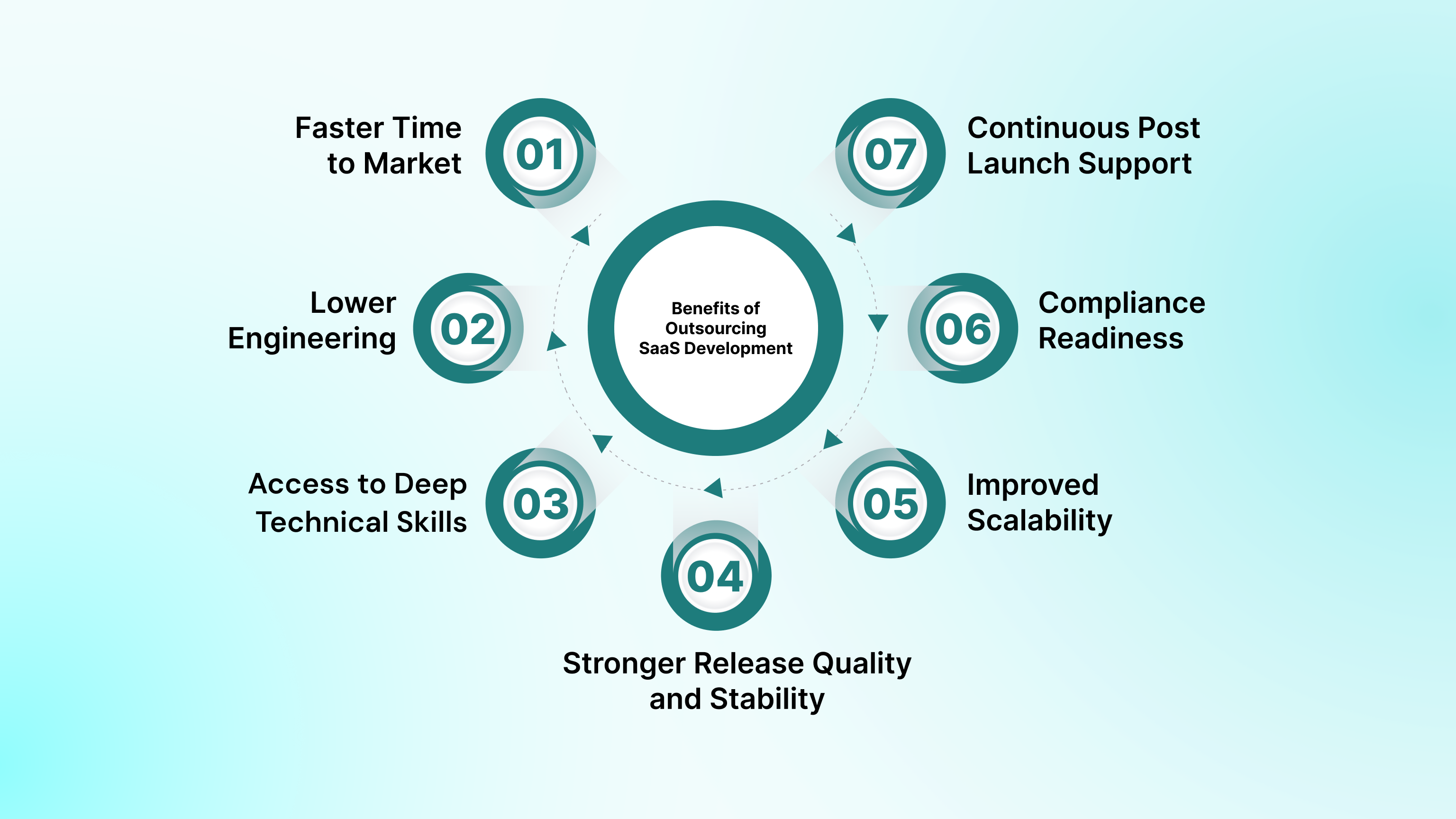
Outsourcing SaaS development improves delivery outcomes by giving teams access to mature engineering workflows, production-grade cloud infrastructure skills, and specialized expertise in multi-tenant design. These gains are measurable across latency reduction, release stability, cost control, and time to market.
1. Faster Time to Market
External teams eliminate slow internal hiring cycles and begin building with proven pipelines and service templates.
- Prebuilt Service Templates: Outsourced teams start with existing boilerplates for auth, billing flows, API versioning, and background workers, which cuts early development time.
- Configured CI Foundations: They come with ready pipelines for container builds, automated tests, and environment provisioning, reducing weeks of initial setup.
- Parallelized Engineering: Backend, frontend, and infrastructure workstreams run concurrently with shared API contracts to avoid idle sprint gaps.
2. Lower Engineering and Operational Costs
Costs drop when specialized workloads move to a team already trained in cloud, DevOps, and performance engineering.
- Reduced Infrastructure Rework: Correct VPC layout, autoscaling policies, and resource tagging prevent cloud misconfigurations that drive unnecessary monthly billing.
- Shared DevOps Capabilities: Instead of hiring DevOps engineers, teams use existing release automation, observability stacks, and incident workflows.
- Fewer Post-Release Regressions: Strong architecture from day one avoids the expensive rewrites common in in-house MVP builds that did not plan for scale.
3. Access to Deep Technical Skills
Outsourcing SaaS development provides immediate access to specialists who handle architectural decisions that define long-term SaaS stability.
- Multi-Tenant Design Expertise: Engineers choose appropriate isolation models and implement row-level controls, tenant-scoped caches, and routing rules that prevent data crossover and performance degradation during high usage.
- Event-Driven Workloads: Teams design asynchronous pipelines using message queues, background workers, and delayed job handlers to manage long-running tasks without blocking API responsiveness or overloading synchronous services.
- Complex Integration Handling: Engineers implement resilient integration patterns such as idempotent requests, token lifecycle management, structured retries, and rate-limit safety guards to keep external system interactions stable under fluctuating load conditions.
4. Stronger Release Quality and Stability
Pipeline automation and strict release controls reduce outages and shorten incident recovery time.
- Automated Regression Gates: Unit, integration, and contract tests run on every merge, blocking deployments that break API behavior or schema assumptions.
- Controlled Rollout Logic: Blue-green, rolling, or canary releases mitigate the risk of pushing unstable builds to all tenants.
- Environment Parity: Provisioned dev, staging, and production environments use identical configs to eliminate drift-related failures.
5. Improved Scalability for Multi-Tenant Platforms
Teams design infrastructure that sustains tenant growth without degradation.
- Isolated Resource Paths: Engineers implement tenant-aware connection pools, scoped caching keys, and throttled workloads to prevent cross-tenant impact.
- Queue-Driven Scaling: Worker pools increase or decrease automatically based on queue depth and job duration thresholds.
- Efficient Data Flows: Sharded tables, partitioned indexes, and optimized read replicas keep p95 latency stable as data volume rises.
6. Better Security and Compliance Readiness
Outsourcing SaaS development brings structured compliance workflows needed for enterprise and regulated markets.
- Audit-Grade Logging: Every admin action, schema update, role change, and configuration modification is logged and retained for SOC 2 or HIPAA evidence trails.
- Strict IAM Segmentation: Access is limited by least privilege across services, environments, and CI pipelines to prevent unauthorized deployment paths.
- Strong API Protection: Teams enforce rate limiting, signature validation, token rotation, and encrypted data handling across all service boundaries.
7. Continuous Post Launch Support
Stable SaaS platforms succeed through ongoing tuning, monitoring, and controlled feature rollout.
- Zero Interruption Updates: Schema migrations run through ghost tables or background migrations to avoid locking large datasets during peak traffic.
- Performance Tuning: Engineers track slow endpoints, cache misses, and DB hotspots, then adjust worker counts, indexes, or query patterns.
- Cost Optimization Cycles: Usage trends inform autoscaling thresholds, database sizing, and storage policies to maintain predictable cloud spend.
Even with strong technical gains on the table, the outsourcing model carries trade-offs that engineering leaders should account for early in the engagement.
For teams working in regulated environments, the sector-specific impact of SaaS platforms is outlined in How Healthcare SaaS Is Shaping Technology in 2025.
Risks to Watch For When You Outsource SaaS Development
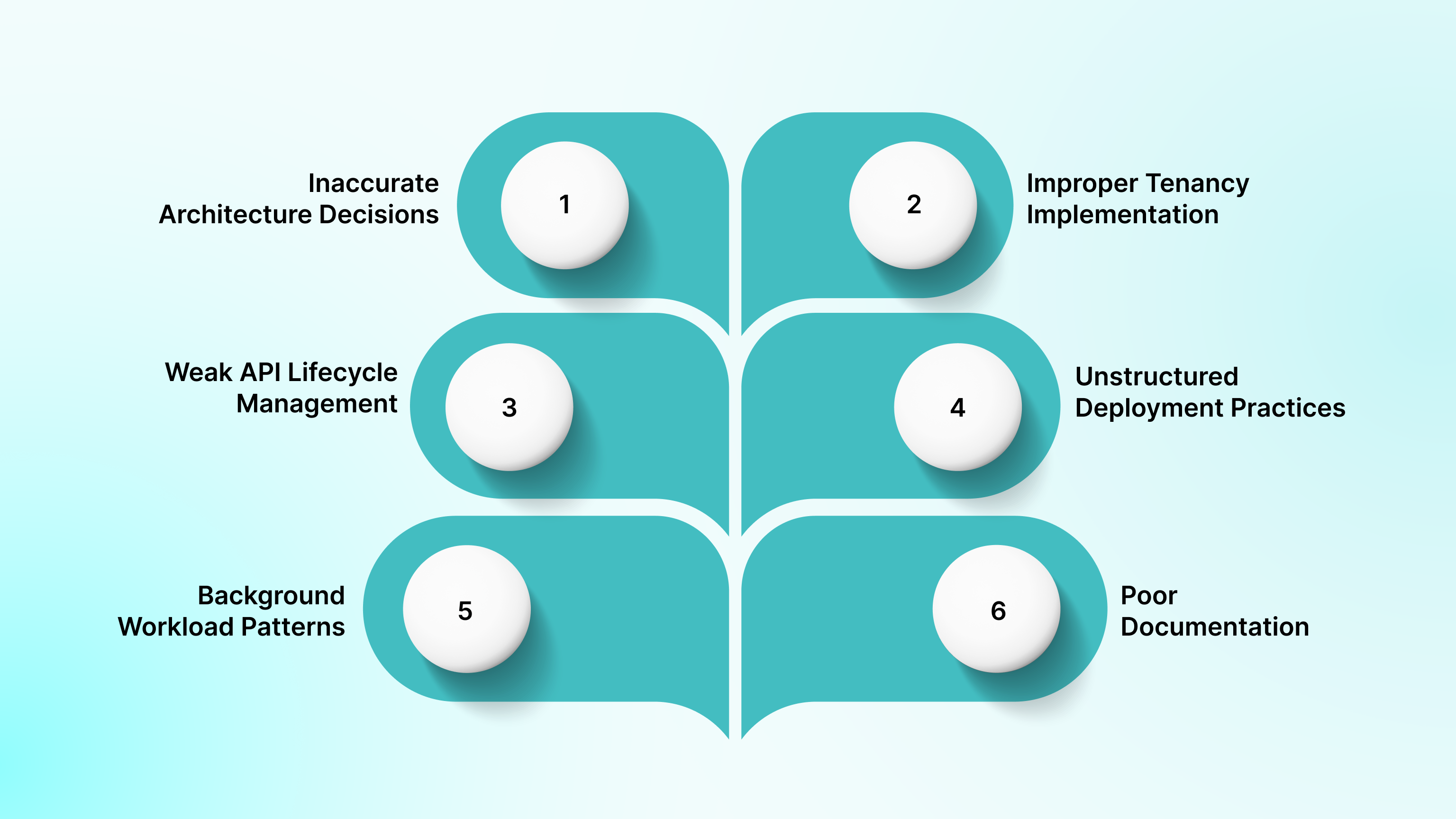
Outsourcing SaaS development carries specific risks when the external team lacks experience with multi-tenant design, regulated data handling, or cloud-native engineering workflows. These risks affect long-term scalability, code ownership, and system reliability if not identified early.
- Inaccurate Architecture Decisions: Vendors who skip domain modeling, data flow mapping, or load assumptions often choose architectures that cannot support tenant growth, complex reporting, or high concurrency.
- Improper Tenancy Implementation: Teams that merge tenant data without row-level protection, scoped caching, or isolated connection pools create exposure risks and unpredictable performance across tenants.
- Weak API Lifecycle Management: Inconsistent versioning, missing contracts, or schema changes pushed without backward compatibility lead to broken billing flows, reporting dashboards, or external integrations.
- Manual or Unstructured Deployment Practices: Vendors relying on ad hoc scripts, untracked environment variables, or inconsistent container builds introduce configuration drift and increase production failure rates.
- Limited Understanding of Background Workload Patterns: Teams that handle long-running tasks synchronously or without queue depth management risk stalled jobs, duplicate state updates, and slow response times during peak usage.
- Poor Documentation and Handover Readiness: Missing runbooks, incomplete environment diagrams, and untracked operational procedures make the codebase difficult for internal teams to manage, increasing dependency on the vendor.
These weak points show why a disciplined delivery structure is crucial for maintaining stability as the product evolves.
Scale your product with experts who handle architecture, cloud, DevOps, and long-term SaaS operations. Connect with DEVtrust to move your platform toward stable, predictable growth.
What a Good SaaS Development Outsourcing Process Looks Like
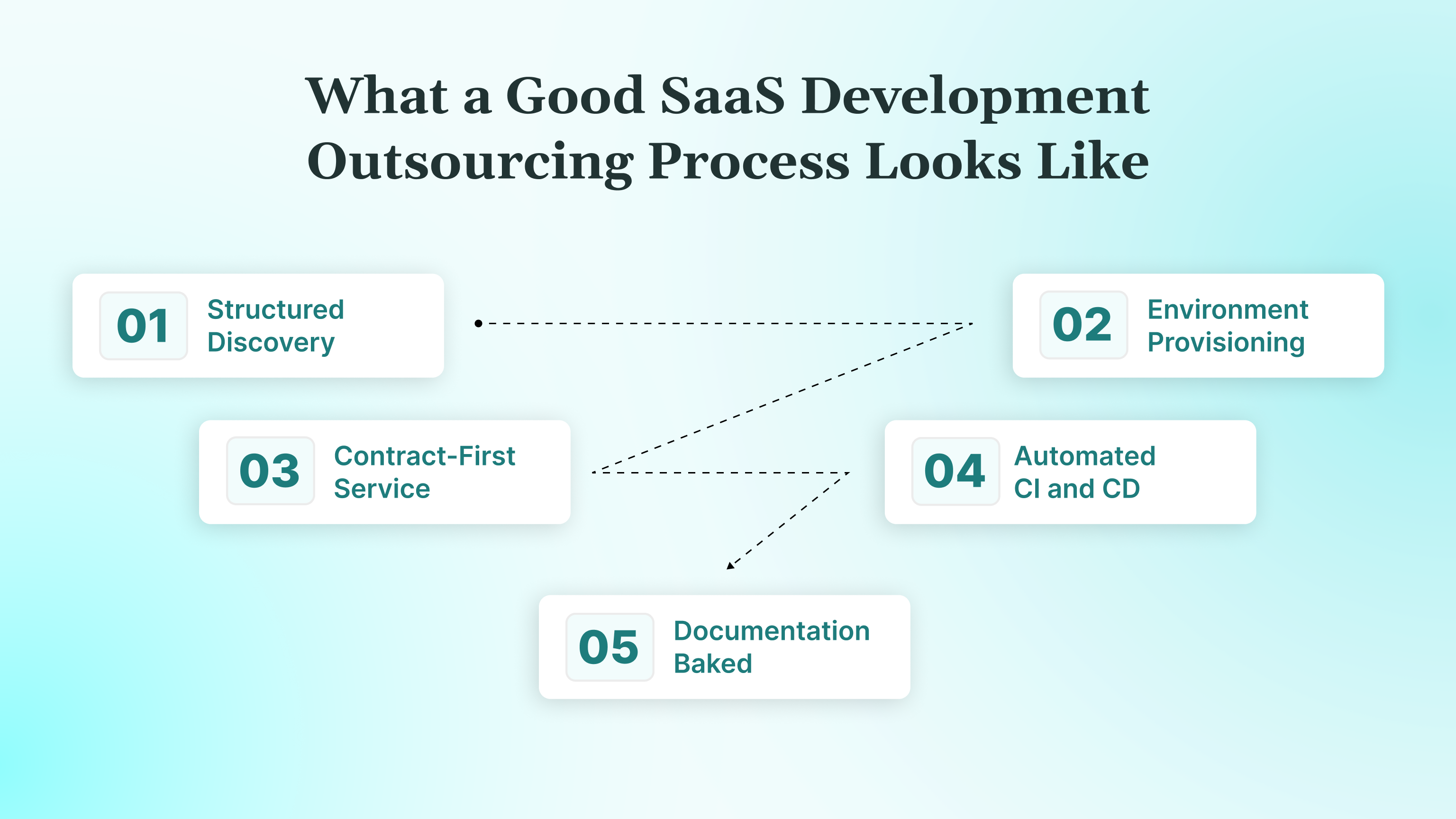
A strong SaaS development outsourcing process is built on disciplined architecture planning, predictable release workflows, and clear separation of responsibilities across teams. The process must support tenant growth, maintain data integrity, and sustain continuous delivery without creating long-term vendor dependency.
- Structured Discovery and Domain Modeling: External teams begin by documenting domain entities, event flows, integration boundaries, and tenant lifecycle rules. This guarantees that the architecture supports concurrency, reporting needs, and future automation.
- Environment Provisioning Through Infrastructure As Code: All environments are created with Terraform or CloudFormation, so networking, compute resources, secrets, and CI-linked environments stay consistent across development, staging, and production.
- Contract-First Service Development: APIs follow documented schemas, versioning rules, and error standards so front-end modules, admin tools, and partner integrations behave consistently across releases.
- Automated CI and CD for Stable Deployments: Pipelines handle builds, tests, vulnerability scans, and staged deployments, using rollback logic and pre-production validation to reduce deployment failures.
- Performance, Reliability, and Documentation Baked Into Delivery: Load tests simulate tenant-level patterns, background job spikes, and integration bursts. Each sprint includes updated architecture diagrams, runbooks, onboarding guides, and operational checklists to support smooth handover.
A process built on structure and predictability sets the groundwork for deciding which delivery model can support your roadmap most effectively.
For teams adjusting their delivery approach to handle evolving requirements, a detailed breakdown is available in Adaptive Software Development Explained: Guide & Key Insights.
In-House vs SaaS Development Outsourcing: When Each Model Makes Sense
SaaS teams choose between in-house and outsourced development based on the complexity of their architecture, required delivery speed, compliance responsibilities, and long-term scalability goals. The table below shows how each model fits different engineering needs.
| Criteria | In-House Makes Sense When | Outsourcing Makes Sense When |
| Architecture Ownership | You need full control of core domain logic, service boundaries, and data modeling for a system with constant internal changes. | You need architects who can design multi-tenant schemas, event flows, API gateways, and isolation strategies that scale cleanly. |
| Engineering Bandwidth | You already have backend, frontend, DevOps, and QA capacity to run parallel workstreams. | You need immediate engineering support for APIs, background jobs, infrastructure, or integrations without waiting for hiring cycles. |
| Compliance Requirements | You maintain SOC 2, HIPAA, or GDPR controls through internal security teams. | You need teams who can implement audit logging, IAM segmentation, and incident evidence workflows for regulated clients. |
| Release Velocity | Your CI and CD pipelines are stable, and your internal team can maintain predictable sprint output. | You need automated testing, staged deployment, rollback rules, and promotion workflows to accelerate shipping. |
| Cost Structure | Budget supports full-time cloud engineers, QA automation, and SRE specialists. | You prefer predictable monthly costs for architecture, DevOps, QA, and maintenance without expanding payroll. |
| Infrastructure Management | You have internal DevOps expertise for IaC, cluster tuning, autoscaling, and observability stacks. | You want managed provisioning, monitoring setup, and performance tuning handled by specialized teams. |
The differences between the two models point directly toward the type of partner that can support complex SaaS workloads, and DEVtrust fits that requirement.
How DEVtrust Helps You Build and Scale Your SaaS Product
DEVtrust supports companies that need strong engineering execution across architecture, cloud, development, and long-term SaaS operations. Whether you are launching a new SaaS platform, improving an existing codebase, or preparing for high-volume tenant growth, DEVtrust provides the technical depth required to build dependable systems.
- Full SaaS Development Support: DEVtrust covers domain analysis, architecture definition, service development, UI engineering, testing, CI/CD setup, and deployment. Teams work across modern frameworks and cloud-native stacks to keep backend, frontend, and infrastructure aligned throughout the project lifecycle.
- Expertise in Multi-Tenant Architecture: Engineers design isolation models, scalable schemas, event-driven workflows, and background processing pipelines that handle high concurrency and tenant-specific workloads. The focus is on building platforms that remain stable as usage patterns and data volume expand.
- Dedicated Engineering Team: You receive a consistent team of backend developers, frontend engineers, QA specialists, and a delivery lead who understand your domain and stay aligned with your roadmap. This continuity supports predictable iteration and long-term platform stability.
- Clear Collaboration with Product Owners: Projects run through structured sprints, documented requirements, shared tracking tools, and scheduled overlap hours. Product owners can review builds, refine priorities, and manage releases with clarity at every stage.
- Security and Compliance Integration: Access governance, audit logs, encryption rules, secret management, and dependency checks are included across environments. These controls help teams meet SOC 2, HIPAA, or GDPR requirements based on the product’s industry.
- Performance and Reliability Focus: DEVtrust teams configure monitoring dashboards, track key metrics, analyze queue depth, and refine caching, SQL queries, or autoscaling thresholds. This makes sure that the platform stays responsive under varying tenant loads.
- Flexible and Scalable Engagement: Start with a focused team for early development, and expand as the product grows. Engineers stay fully onboarded across releases, avoiding interruptions and reducing context transfer time.
Case Study: Moveit4U
DEVtrust partnered with Moveit4U, an Australia-based Transportation Management System (TMS), to simplify operations and strengthen platform reliability. The team automated key workflows, improved the interface, and integrated secure payment handling to support a more efficient logistics experience.
- Improved Operational Efficiency: Automated core processes across dispatch and load management, resulting in a 50% reduction in manual efforts and faster task completion for internal teams.
- Improved User Experience: Refined the interface with clearer navigation and updated layouts, leading to a 40% increase in user satisfaction among fleet managers and dispatch operators.
- Integrated Reliable Payments: Implemented Stripe for real-time payments and accurate reconciliation, contributing to a 25% improvement in timely payments and smoother financial operations.
- Stable Performance During Peak Usage: Optimized infrastructure and controlled deployment practices delivered zero downtime during high-traffic periods, supporting uninterrupted logistics operations.
DEVtrust allows SaaS companies to strengthen their architecture, maintain release stability, and scale their product with predictable and reliable engineering processes.
Conclusion
Outsourcing SaaS development gives companies a clear path to stabilize their product, improve delivery speed, and access engineering depth without expanding internal teams. With the right structure in place, outsourced teams can help you strengthen architecture, maintain consistent releases, and build a platform that supports long-term growth.
If you are improving an existing SaaS product or preparing to launch a new one, outsourcing SaaS development allows you to add cloud, DevOps, and multi-tenant expertise without long hiring cycles or infrastructure bottlenecks.
DEVtrust supports SaaS teams through architecture planning, development, testing, infrastructure setup, and continuous optimization. The team stays aligned with your roadmap and provides the technical clarity required to build dependable systems.
Talk to DEVtrust to plan your next build, and see how a structured engineering approach can help you scale your SaaS product with confidence.
Frequestly Asked Questions
Related Articles
Software Development Outsourcing
An Ultimate Guide to Python Software Development in 2026
Software Development Outsourcing
Why Outsourcing Software Development to India Is a Smart Choice
Software Development Outsourcing