


Building software is getting harder. Teams are expected to move fast, maintain high quality, and still control costs. For many businesses, doing all of this with only in-house teams is no longer realistic. That’s why more companies are turning to nearshore software development; working with skilled teams in nearby countries, without losing day-to-day collaboration.
This shift isn’t small. The global software development outsourcing market is expected to reach USD 897.44 billion by 2030, and nearshore outsourcing is set to grow even faster, at a 14.5% CAGR between 2025 and 2030. Companies are choosing nearshore not just to save money, but to build and ship software faster.
This guide is for CTOs, product managers, and engineering leaders who want to use nearshore teams the right way. You’ll learn how to choose a nearshore partner and integrate them into your projects without slowing things down.
Overview
- Nearshore software development involves outsourcing to nearby countries with similar time zones. This ensures real-time collaboration and smoother communication compared to offshore models.
- Nearshore offers cost-efficiency by providing access to skilled talent at competitive rates, while maintaining high-quality standards and faster project delivery.
- Nearshore models like staff augmentation, agile teams, and outcome-based projects offer flexibility to scale teams and adapt to project needs.
- Leading nearshore companies such as DEVtrust, N‑iX, BairesDev, 10Pearls, and Gorilla Logic provide specialized expertise and agile solutions for businesses.
- To choose the right partner, assess project needs, cultural fit, communication practices, and technical expertise to ensure smooth collaboration and project success.
What is Nearshore Software Development?
Nearshore software development involves outsourcing software development to companies in nearby countries, typically within the same or similar time zones. This model offers access to skilled talent while enabling seamless real-time collaboration, providing a clear advantage over offshore development in terms of communication and project efficiency.
How Nearshore Fits into the Broader Outsourcing Model?
In the context of outsourcing, three main models stand out: onshore, offshore, and nearshore. Understanding their differences is essential in choosing the best fit for your project:
| Aspect | Nearshore Development | Offshore Development | Onshore Development |
| Time Zones | Similar time zones enable real-time collaboration and efficient project management, minimizing delays. | Time zone differences of 8-12 hours create challenges for synchronous communication, leading to delays. | The same time zone ensures instant collaboration, but comes with a higher cost. |
| Cultural Differences | Culturally similar regions promote better communication and alignment, creating smooth workflows. | Cultural differences and language barriers may affect understanding, affecting collaboration quality. | Cultural alignment is ideal, but often leads to high salaries and limited scalability. |
| Cost-Efficiency | Cost-effective, typically ranging from $50 to $100 per hour, offering a balance between quality and pricing. | More affordable but may incur hidden costs due to inefficiencies, project delays, and communication issues. | The most expensive option, with developers charging $150–200 per hour, but it guarantees top-tier local talent. |
| Talent Pool | Access to skilled talent in nearby regions with strong tech ecosystems and lower salaries than onshore. | Offers a large talent pool but may struggle with communication and slower response times. | Access to highly skilled local talent. However, it’s often limited to expensive talent pools with fewer options. |
| Team Integration | Nearshore teams integrate easily into your operations with minimal cultural differences and effective collaboration tools. | Offshore teams may experience integration difficulties due to time zone challenges and cultural misalignment. | Full integration into your operations with local teams, though, often requires higher budget allocation. |
| When to Choose | Ideal when you need cost-efficiency combined with quality and quick turnaround, especially with similar work cultures. | Best for cost-cutting, but at the risk of communication delays and project inefficiencies due to time zone differences. | Best when you prioritize close collaboration and high-quality work, but are willing to invest more in local talent. |
With a clear understanding of how nearshore compares to offshore and onshore models, it’s important to explore how nearshore development can be smoothly integrated into your business.
Also Read: Outsource SaaS Development in 2026: Benefits and Risks
How Nearshore Development Works?
Nearshore development offers flexible models tailored to your specific project needs. Depending on your goals, you can choose from staff augmentation, dedicated agile teams, or outcome-based projects, each providing a unique approach to collaboration and scalability.
1. Staff Augmentation
Staff augmentation allows companies to integrate nearshore developers directly into their existing teams on a temporary basis. This model is ideal for businesses that require specialized skills for a short-term project or to scale resources during peak workloads.
Nearshore staff can easily blend into your workflow, using tools like Jira, Trello, or Slack to collaborate effectively. With this approach, you avoid the overhead of hiring full-time employees, while still gaining access to a skilled talent pool for specific needs.
2. Dedicated Agile Teams
With dedicated agile teams, nearshore developers act as a remote extension of your in-house team, focusing solely on your projects. These teams follow agile methodologies, working in sprints and adapting quickly to changing requirements. This model is ideal for long-term projects that require consistent attention and flexible scaling, such as building SaaS platforms or developing enterprise-level systems.
By using agile principles, you can ensure continuous progress, frequent iterations, and immediate feedback, making the development process more transparent and efficient.
3. Outcome-Based Projects
Outcome-based projects shift the focus from time spent to results delivered. In this model, a nearshore custom software development team defines milestones and deliverables, with payments linked to the completion of specific objectives. This is ideal for businesses that need clear, measurable progress at each stage.
For example, a mobile app development project may have set milestones for UI design, backend integration, and user testing. Payments are tied to achieving these milestones, ensuring both teams are aligned on goals and progress.
With these three models, nearshore development provides the flexibility to adapt to different project types and business needs. Now, let’s explore the key benefits of nearshore software development and how it can boost your company’s growth.
5 Benefits of Software Development Outsourcing Nearshore
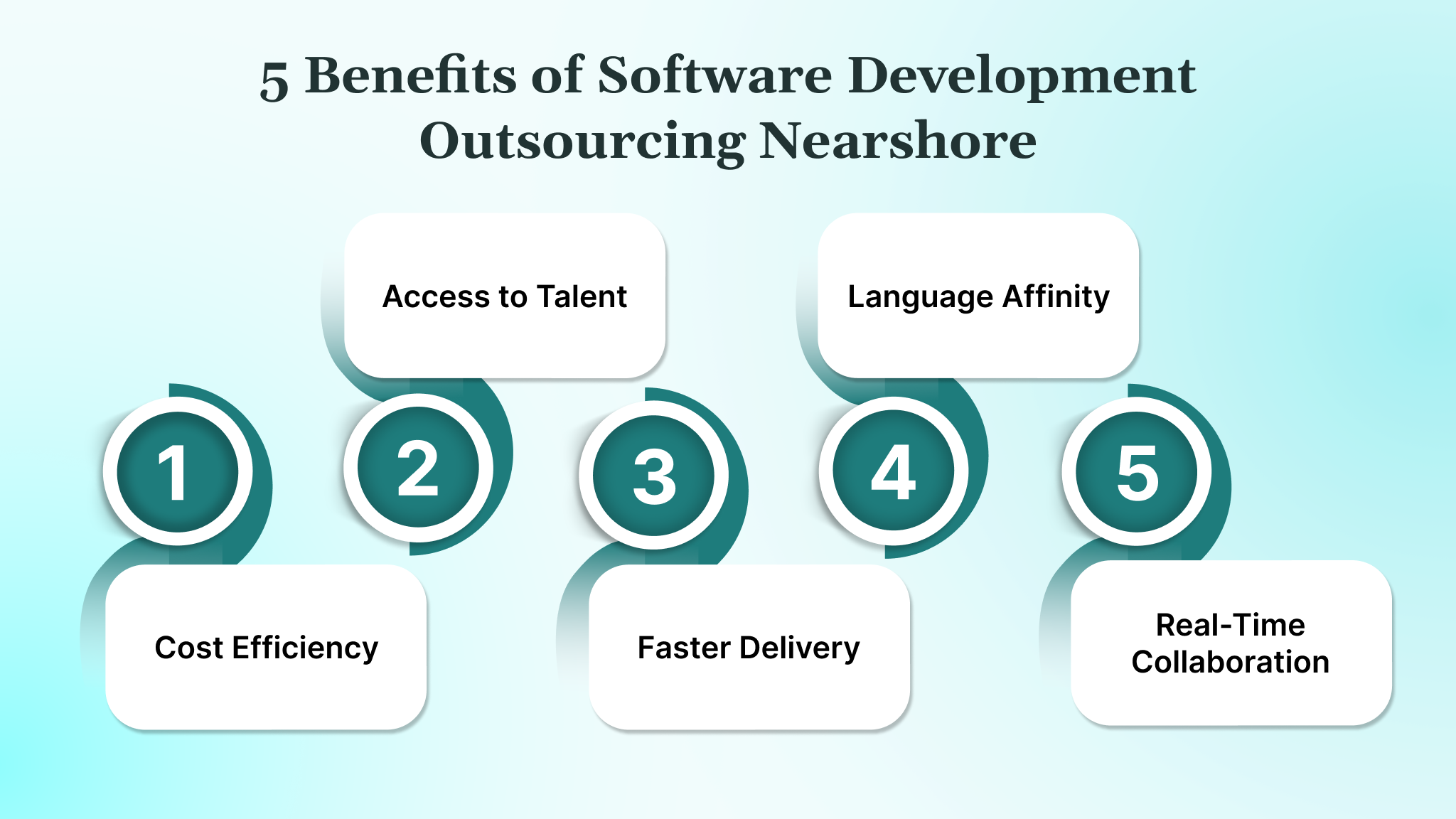
Nearshore software development is increasingly popular due to its unique benefits. It offers cost efficiency, access to skilled talent, and enhanced collaboration, making it the preferred model for many businesses seeking high-quality development at a reasonable cost.
1. Cost Efficiency
Nearshore development allows businesses to save 30-40% compared to onshore rates by using regions with lower labor costs while maintaining high-quality standards. For example, outsourcing software development to Mexico or Colombia offers significant cost savings over U.S.-based hiring without compromising quality.
2. Access to Talent
Nearshore teams provide access to a skilled talent pool without time zone challenges. For example, Eastern Europe offers expertise in Java and Python, while Latin America specializes in mobile development and cloud services. This allows companies to find the right talent efficiently.
3. Faster Delivery with Proximity
The geographic proximity of nearshore teams enables real-time collaboration, eliminating delays common with offshore teams. Nearshore teams work in similar time zones, which ensures quick feedback loops and faster project delivery, reducing overhead and supporting development cycles.
4. Cultural & Language Affinity
Nearshore teams from regions like Latin America or Eastern Europe share similar work cultures and language proficiency with U.S. or European counterparts. This promotes smoother communication, reducing misunderstandings, and increasing collaboration speed.
5. Real-Time Collaboration
Unlike offshore teams, nearshore development facilitates real-time collaboration, enabling your teams to make quick decisions and resolve issues instantly. With tools like Slack and Zoom, nearshore teams work effectively alongside in-house teams, ensuring immediate feedback and efficient project execution.
These benefits highlight why nearshore software development is gaining popularity. However, there are still challenges to address. In the next section, we’ll explore these challenges and how to overcome them to ensure a successful nearshore development partnership.
Nearshore Development Challenges and How to Overcome Them
Nearshore development can deliver speed and cost advantages, but only when execution risks are addressed upfront. The most common failures are not about talent or time zones. They stem from ownership, security, and operational drift.
1. IP Ownership, Code Rights, and Repository Control
One of the fastest ways a nearshore engagement fails is ambiguity around who owns the code, who controls the repositories, and what happens if the relationship ends. If the vendor owns the repo or key assets, transitions become expensive and risky.
How to address it:
Define IP ownership in the contract from day one. Ensure repositories live in the client’s organisation, with role-based access and documented contribution rules. Access should be revocable at any time without blocking delivery.
2. Security Model and Access Discipline
Nearshore teams often start with broad access “for speed,” which quickly becomes a liability. Weak controls around SSO, device usage, secrets, and environments expose systems to unnecessary risk.
How to address it:
Enforce single sign-on, least-privilege access, approved device policies, and centralised secrets management. Separate environments clearly and audit access regularly, rather than relying on trust alone.
3. Exit Planning and Knowledge Transfer
Many engagements assume continuity and fail to plan for change. When a vendor swap or internalization becomes necessary, undocumented systems and tribal knowledge can stall progress for months.
How to address it:
Define an exit plan upfront. Require living documentation, architectural diagrams, onboarding guides, and regular knowledge handoffs to ensure the project remains portable regardless of vendor.
4. Engineering Standards Drift
Over time, inconsistent coding practices, weak reviews, and relaxed testing standards creep in. This “standards drift” increases defects, slows velocity, and makes scaling harder.
How to address it:
Set explicit engineering standards early: linting rules, test coverage thresholds, code review SLAs, and definition-of-done criteria. Enforce them through CI pipelines rather than manual oversight.
5. Expectation Alignment and Delivery Transparency
Misalignment around priorities, scope, and success metrics still causes friction, especially when communication becomes status-heavy but insight-light.
How to address it:
Anchor the engagement around outcomes and KPIs, not just tasks. Use weekly reviews tied to deliverables, risks, and decisions rather than generic progress updates.
Nearshore development succeeds when ownership, security, and standards are treated as first-class concerns, not afterthoughts. Teams that lock these foundations early preserve flexibility, reduce risk, and maintain leverage throughout the engagement.
Up next, we’ll explore how to evaluate and select nearshore partners based on these exact criteria, not just cost or location.
Top 5 Nearshore Software Development Outsourcing
Selecting a top nearshore development partner can drastically impact your project’s success. Here are five industry-leading companies that specialize in providing nearshore solutions with real-time collaboration and high-quality delivery.
1. DEVtrust

DEVtrust excels as a global software development partner offering a hybrid approach with nearshore agility and offshore scalability. Specializing in AI, machine learning, and mobile development, we provide cost-effective, high-quality solutions while maintaining real-time collaboration and cultural alignment for clients. Take a look at our impactful case studies.
2. N‑iX
Source:- https://www.n-ix.com/
N‑iX is renowned for its enterprise-grade nearshore development, with delivery hubs in Latin America and Eastern Europe. Specializing in cloud solutions, AI, and data analytics, N‑iX provides full-stack development services, ensuring high-quality delivery and effective integration for businesses looking to scale and innovate rapidly across regions.
3. BairesDev

Source:- https://www.bairesdev.com/
BairesDev stands in the top 1% of engineers from Latin America, offering scalable nearshore development solutions. With expertise in mobile apps, cloud services, and full-stack development, BairesDev supports rapid scalability for U.S. and European clients, ensuring timely delivery, seamless integration, and high-quality results throughout the process.
4. 10Pearls
Source:- https://10pearls.com/
10Pearls excels in nearshore agile development, specializing in digital transformation and cybersecurity. Operating from Latin American hubs, they provide real-time collaboration and secure solutions for U.S. and European companies. Their nearshore teams drive rapid, iterative development, ensuring flexibility and timely delivery of business-critical solutions.
5. Gorilla Logic
Source:- http://gorillalogic.com/
Gorilla Logic offers nearshore agile pods that integrate directly with clients’ internal teams, providing real-time collaboration and scalability. Specializing in DevOps, QA, and product engineering, their nearshore teams in Costa Rica, Colombia, and Mexico ensure smoother integration, quick iterations, and rapid scalability to meet various business needs.
By utilizing the strengths of these nearshore experts, you’ll achieve cost-effective scalability, faster time-to-market, and efficient team integration. But how do you choose the right nearshore software development remains the question?
Also Read: Choosing The Best Offshore Software Development Company In 2025
How to Choose the Right Nearshore Software Development Company?
Choosing the right nearshore partner requires thorough due diligence. Here’s a step-by-step guide to help you select the right company:
- Assess your project needs and goals: Clearly define the project’s scope, timeline, and budget to find nearshore teams that align with your needs.
- Research potential partners: Focus on nearshore companies with deep expertise in your industry and tech stack, and evaluate client feedback.
- Verify credentials and case studies: Ensure the nearshore partner holds relevant certifications (e.g., ISO, SOC 2) and has a proven portfolio of similar projects.
- Evaluate communication practices: Conduct a video call to assess responsiveness, clarity in communication, and the team’s ability to explain technical challenges.
- Cultural fit and values alignment: Ensure the nearshore team’s work culture, business values, and operational practices align with your company to avoid friction.
- Check financial stability: Assess the financial health of the nearshore company to ensure it can sustain long-term collaborations and scale with your needs.
Following these steps ensures a nearshore partner that suits your specific project needs. Now, let’s move on to practical tips for working effectively with your nearshore team.
Practical Tips for Successful Nearshore Software Development
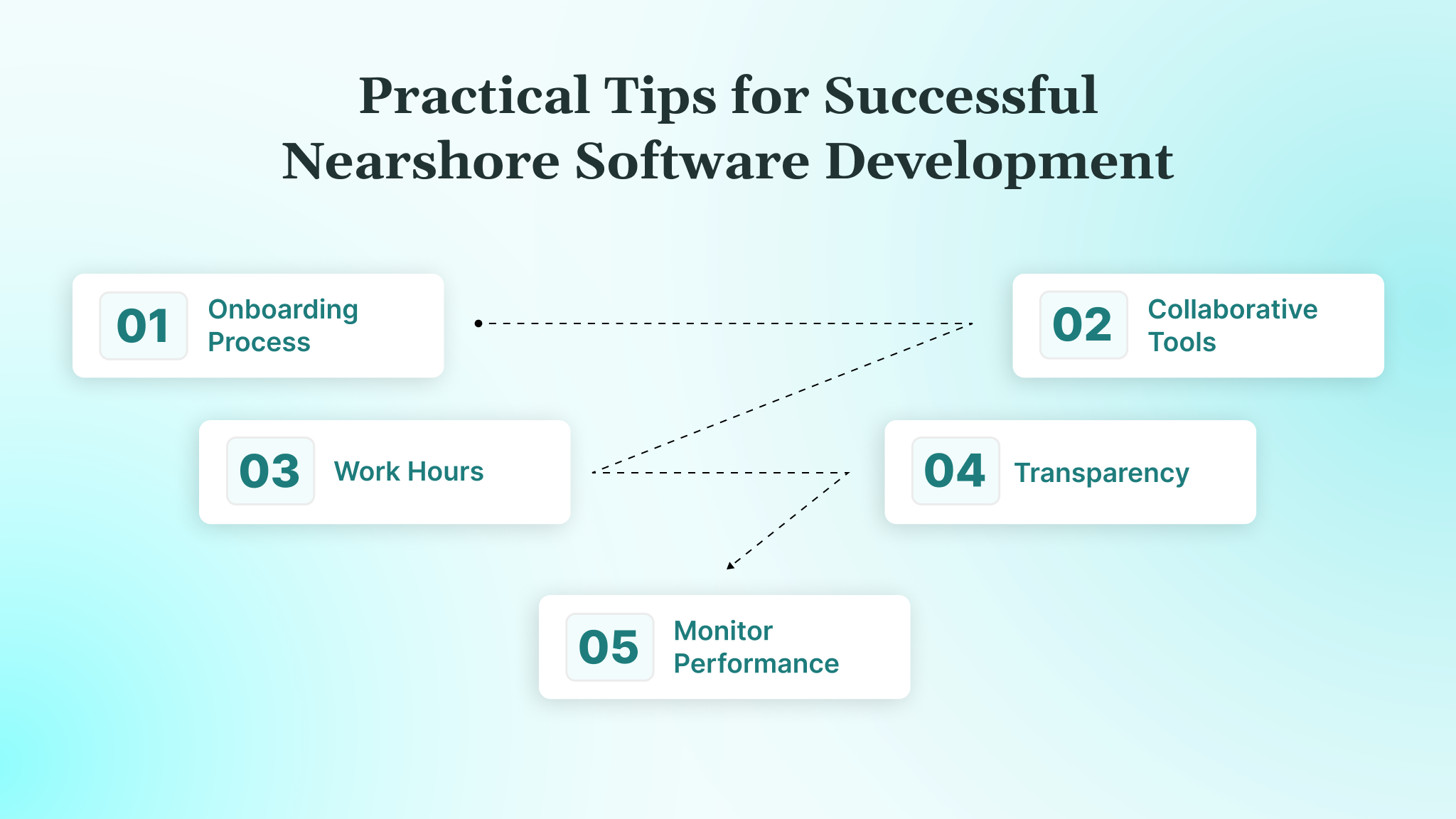
To optimize your nearshore development efforts, it’s essential to follow best practices that ensure smooth collaboration, clear communication, and consistent progress. These practical tips will guide you through making the most of nearshore partnerships.
Tip 1: Define Clear Expectations & Onboarding Process
From the outset, ensure clear roles, responsibilities, and deliverables are defined. Establish effective communication protocols and detailed workflows for managing tasks. This prevents confusion later, especially when working across regions with different time zones, ensuring alignment from day one.
Tip 2: Utilize Collaborative Tools
To simplify project management, use Slack, Jira, or Trello for task tracking and team coordination. These tools enable real-time updates, build transparent communication, and keep everyone aligned. This way, your deadlines are met, and progress is visible at every stage of the project.
Tip 3: Align On-Time Zone & Work Hours
Set clear expectations for working hours and handle time zone differences upfront. Establish synchronous working hours for real-time communication and asynchronous practices for off-hours, ensuring both teams work efficiently and are available for key discussions, reducing delays and miscommunication.
Tip 4: Adopt an Agile Methodology for Flexibility and Transparency
Implement an agile methodology, breaking your project into sprints with clear milestones and deadlines. Regular feedback loops and iterative cycles allow your team to adjust quickly, address concerns, and stay on track, while promoting transparency and continuous improvement throughout development.
Tip 5: Track Engineering Performance With Clear KPIs
Nearshore delivery breaks down when performance is assessed subjectively. Teams need shared, objective metrics across delivery, quality, operations, and collaboration.
- Delivery Metrics: Track cycle time, lead time, throughput, and sprint predictability to understand how reliably work moves from commit to production.
- Quality Metrics: Monitor defect escape rate and change failure rate to ensure speed does not come at the cost of stability.
- Operational Metrics: Measure mean time to recovery (MTTR) along with incident count and severity to assess system resilience and on-call effectiveness.
- Collaboration Metrics: Track pull request review time, blocker age, and async response SLAs to surface friction in cross-team collaboration.
Dashboards typically combine Jira delivery views, CI/CD metrics, and incident management tooling to create a single source of truth for execution health.
By grounding performance in engineering KPIs, teams maintain transparency, catch issues early, and keep nearshore collaboration predictable and scalable.
Costs of Nearshore Software Development: What You Should Know
Nearshore development offers cost savings, with developers charging $50-100 per hour, much lower than $150-250 per hour for onshore teams. However, you should factor in hidden costs like project management tools, training, and travel expenses for in-person meetings.
For long-term projects, also consider ongoing maintenance and support costs post-launch, which can range from 5-15% of the initial project cost annually. Accounting for these expenses ensures more accurate budgeting and helps maintain long-term project sustainability without unexpected financial strain.
Top Nearshore Development Locations in Latin America and Europe
When selecting the ideal nearshore development location, businesses should carefully evaluate factors like proximity, technical expertise, and cost efficiency. Latin America and Eastern Europe stand out as prime regions offering a balance of talent and affordability.
- Latin America: Countries like Mexico, Argentina, and Colombia offer a highly skilled workforce with expertise in Java, Python, React, and Node.js. Their strong tech ecosystems and cultural alignment with the U.S. enable efficient collaboration and cost-effective solutions for U.S.-based businesses.
- Eastern Europe: Poland, Ukraine, and Romania excel in AI, blockchain technology, and cloud development, offering highly cost-effective services for European companies. Developers in these regions have strong proficiency in JavaScript, C#, and DevOps, making them ideal for complex technical projects.
Choosing the right nearshore location, like Latin America or Eastern Europe, ensures you access top talent, reduces costs, and improves collaboration. The right region makes all the difference in achieving your project goals efficiently.
Also Read: Top 10 Custom Software Development Companies in 2026
Why DEVtrust’s Nearshore Teams Are the Ideal Fit for Your Development Needs?
As businesses adopt nearshore software development, they often struggle with finding the right partner who can deliver real-time collaboration, maintain high-quality standards, and offer scalable solutions at competitive costs while ensuring security and compliance.
DEVtrust offers a nearshore solution tailored to these challenges, providing businesses with access to skilled teams in AI, mobile development, and cloud services. With real-time collaboration, security compliance, and a proven track record, we ensure high-quality development at cost-effective rates. We provide nearshore teams that integrate effectively into your workflows, ensuring agility and efficiency.
Here’s what we offer at DEVtrust:
- Expertise in AI, mobile development, and cloud solutions
- Full PCI-DSS and SOC 2 compliance for secure development
- Seamless integration with existing in-house teams using agile methodologies
- Scalable, cost-efficient solutions that grow with your business
- Real-time collaboration for faster decision-making and issue resolution
DEVtrust ensures your nearshore development is both efficient and secure, delivering high-quality results aligned with your business goals.
Conclusion
Nearshore software development offers businesses the ability to optimize costs, boost project timelines, and access skilled talent from regions with time-zone alignment. By partnering with the right nearshore team, companies can scale their development efforts while maintaining high standards of quality and collaboration.
DEVtrust stands out with its expertise in delivering high-quality software solutions tailored to your needs. With deep capabilities in AI, machine learning, and mobile development, we encourage close collaboration, enabling rapid innovation and efficient project delivery, no matter your industry.
Talk to our team today and explore how DEVtrust can simplify your nearshore development process!
Frequestly Asked Questions
Related Articles

Custom Software Development
Enterprise Application Integration: What It Is and How It Works

Custom Software Development
How to Build a CRM in 2026: Step-by-Step Guide

Custom Software Development