The blockchain market reached $20.03 billion in 2024 and is projected to hit $393.45 billion by 2030. This growth signals a fundamental shift in how enterprises handle transactions, data integrity, and trust.
For CTOs and Product Managers, this creates both opportunity and pressure. You need to understand whether blockchain solves your specific problem or adds unnecessary complexity. You need to know which platform meets your compliance requirements, how to budget for development, and which technical decisions will affect your ability to scale.
This guide cuts through the noise. You’ll find actionable technical details on building blockchain applications, real cost breakdowns, and decision frameworks used by companies already deploying these systems in production.
Key Takeaways
- Blockchain application development is effective only when a product requires shared trust, tamper-proof records, or automated multi-party workflows.
- Choosing the right blockchain type and platform early determines scalability, compliance readiness, and long-term operating cost.
- Enterprise blockchain development costs typically range from 30,000 dollars for MVPs to 500,000 dollars or more, driven by security, integrations, and regulatory requirements.
- Successful blockchain mobile apps rely on hybrid architectures that keep critical logic on-chain and performance-intensive data off-chain.
- Blockchain ROI is achieved through disciplined scope, security-first execution, and clear alignment with measurable business outcomes.
What Is Blockchain App Development?
Blockchain app development is the process of building applications that run on decentralized networks, where data is shared across multiple nodes.
Transactions are grouped into blocks, linked using cryptography, and copied across the network. Once recorded, the data cannot be changed without network agreement.
Unlike traditional apps that rely on centralized databases controlled by one organization, blockchain applications use distributed ledgers. This allows multiple parties to verify data directly, without depending on a trusted intermediary. As a result, blockchain apps are well-suited for use cases that require data integrity, traceability, and shared trust.
Key technical differences
- Data storage: Traditional applications store data in relational or NoSQL databases, which are managed by the application owner. Blockchain apps persist records on distributed ledgers such as Ethereum or Hyperledger, with each participating node maintaining the same state.
- Transaction validation: In standard systems, transactions are approved by server-side logic and access controls. Blockchain networks validate transactions collectively through consensus algorithms like Proof of Work or Proof of Stake before data is committed.
- Data modification: Conventional databases allow direct updates or deletions. Blockchain ledgers are append-only, meaning changes are recorded as new transactions, thereby preserving an immutable, auditable history.
These characteristics make blockchain app development suitable for applications that require verifiable data integrity, shared ownership, and long-term traceability across multiple stakeholders.
Why Should You Consider Blockchain in Mobile App Development?
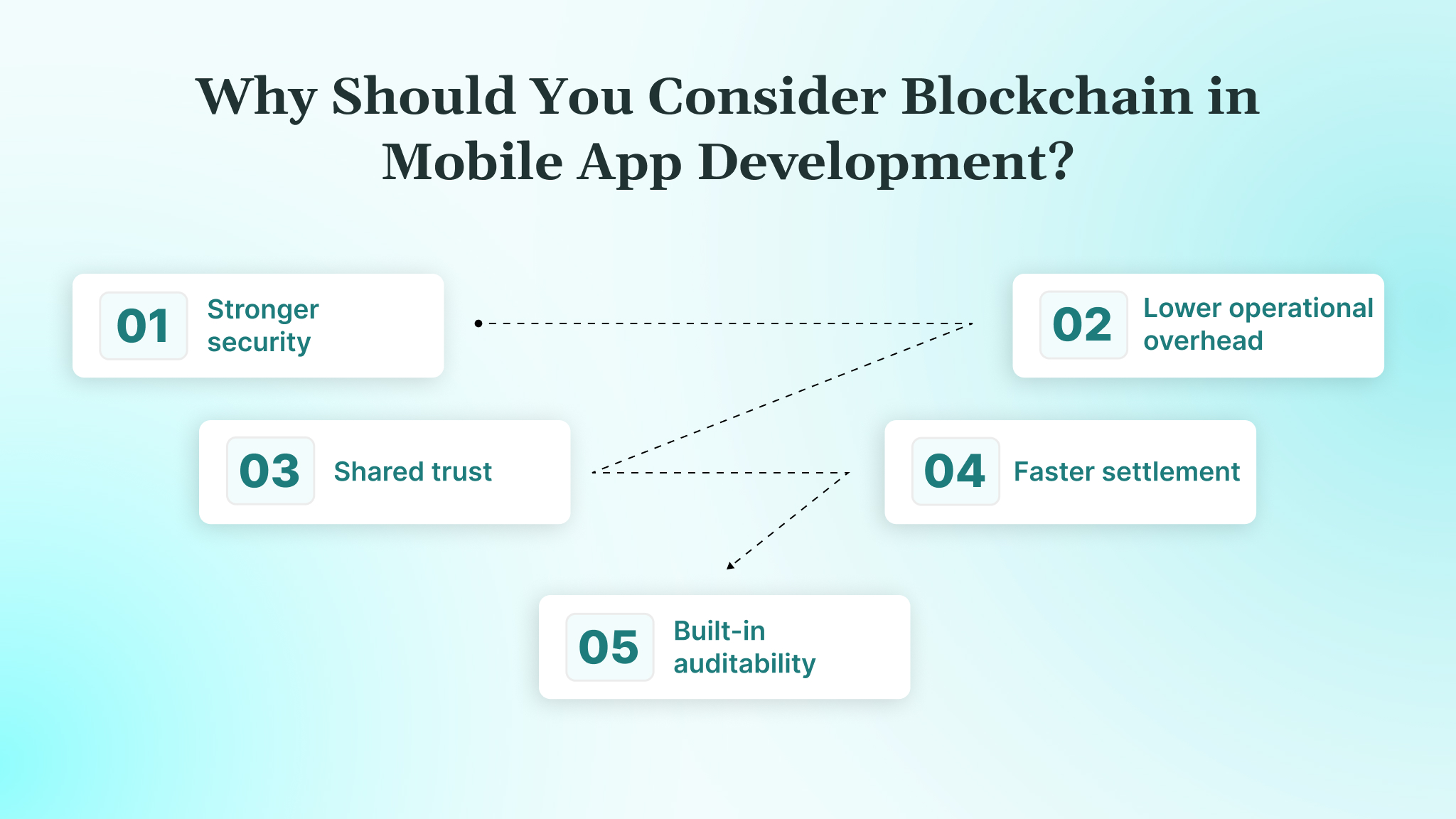
You should consider blockchain in mobile app development when your mobile application handles high-value actions across users, organizations, or devices that do not fully trust each other. To decide better, here are the strengths of blockchain app development
Blockchain strengthens mobile applications in the following ways:
- Stronger security for mobile-initiated transactions: Mobile actions such as payments, approvals, or asset transfers are cryptographically signed and recorded on a distributed ledger. Altering a single record would require rewriting subsequent blocks across most network nodes, making tampering impractical even if a backend system is compromised.
- Lower operational overhead in mobile workflows: Smart contracts automate rule-based processes triggered from mobile apps. Payments, claims submissions, or supply chain updates initiated by users execute automatically once conditions are met, reducing backend processing, reconciliation, and manual intervention.
- Shared trust for multi-party mobile platforms: When your mobile app connects customers, partners, vendors, or regulators, blockchain provides a single, verifiable source of truth. All parties can independently confirm transactions without relying on your app server as the sole authority.
- Faster settlement for real-time mobile use cases: Blockchain removes multi-layer intermediaries from transaction flows. Mobile-initiated transactions that traditionally take days to settle can be completed in minutes, enabling real-time user experiences across regions.
- Built-in auditability for compliance-driven mobile apps: Every action triggered from the mobile app is timestamped and immutable on-chain. This simplifies audits and compliance reporting while keeping sensitive user data off-chain.
Blockchain in mobile app development is most effective when your application coordinates trust, value, or verification across multiple parties, not when all users and data are controlled by a single organization.
Need help determining if blockchain fits your technical requirements? Book a consultation with DEVtrust’s blockchain architects.
Types of Blockchain Applications
Not all blockchain implementations serve the same purpose. The type you choose directly impacts who can participate, how you manage permissions, and which compliance requirements apply.
The most common types are:
Public Blockchains
Open networks where anyone can join, validate transactions, and view the complete ledger history. Bitcoin and Ethereum operate as public blockchains.
Best for:
- Applications requiring maximum decentralization.
- Projects where transparency to all parties adds value.
- Systems that need to operate independently of any single organization.
- Consumer-facing cryptocurrency services.
Trade-offs:
- Slower transaction speeds due to consensus requirements across thousands of nodes.
- Higher costs from network gas fees during peak usage.
- Limited privacy since all transactions are publicly visible.
- Regulatory uncertainty for some use cases.
Private Blockchains
Permissioned networks where a single organization or consortium controls who can participate and validate transactions. Hyperledger Fabric and Corda are common private blockchain platforms.
Best for:
- Enterprise applications with known participants.
- Scenarios requiring compliance with data privacy regulations.
- Systems needing high transaction throughput.
- Organizations that must maintain control over governance.
Trade-offs:
- Less decentralized than public chains, reintroducing some trust requirements.
- Requires infrastructure investment to operate nodes.
- Custom development is often needed for specific business logic.
- Limited interoperability with other blockchain networks.
Consortium Blockchains
Semi-decentralized networks where multiple organizations share control. No single entity can unilaterally change the rules, but participation is restricted to approved members.
Best for:
- Industry collaborations (banking consortiums, supply chain alliances).
- Scenarios where competitors need to share certain data.
- Regulatory environments requiring known participants.
- Cross-organizational workflows with shared governance.
Trade-offs:
- Governance complexity increases with more participants.
- Slower decision-making for protocol upgrades.
- Still requires some level of mutual trust between organizations.
- May face the same scalability challenges as public chains.
Decentralized Applications (dApps)
Frontend interfaces that interact with smart contracts on public blockchains. Users maintain control over their assets and data rather than relying on the application provider.
Best for:
- DeFi protocols (lending, trading, yield farming).
- NFT marketplaces and digital collectibles.
- Decentralized social networks and content platforms.
- Gaming applications with player-owned assets.
Smart Contract Platforms
Blockchains are designed to execute programmable logic beyond simple transactions. Ethereum pioneered this category, now joined by Solana, Avalanche, and others.
Best for:
- Automated escrow and payment releases.
- Token issuance and management.
- Decentralized autonomous organizations (DAOs).
- Complex multi-party agreements requiring automated enforcement.
Tokenized Ecosystems
Systems where blockchain-based tokens represent real or digital assets, enabling fractional ownership, easier transferability, and programmatic control.
Best for:
- Real estate tokenization for fractional investment.
- Supply chain tokens representing physical goods in transit.
- Loyalty programs with transferable points.
- Carbon credits and environmental assets.
Enterprise Blockchain Solutions
Production-grade implementations optimized for business requirements, including permissioned access, integration with legacy systems, and enterprise support.
Best for:
- Trade finance and letters of credit.
- Identity verification and KYC processes.
- Medical records management.
- Intellectual property tracking
Also Read: How to Develop AI Software: A Complete Guide
Step-by-Step Blockchain App Development Process
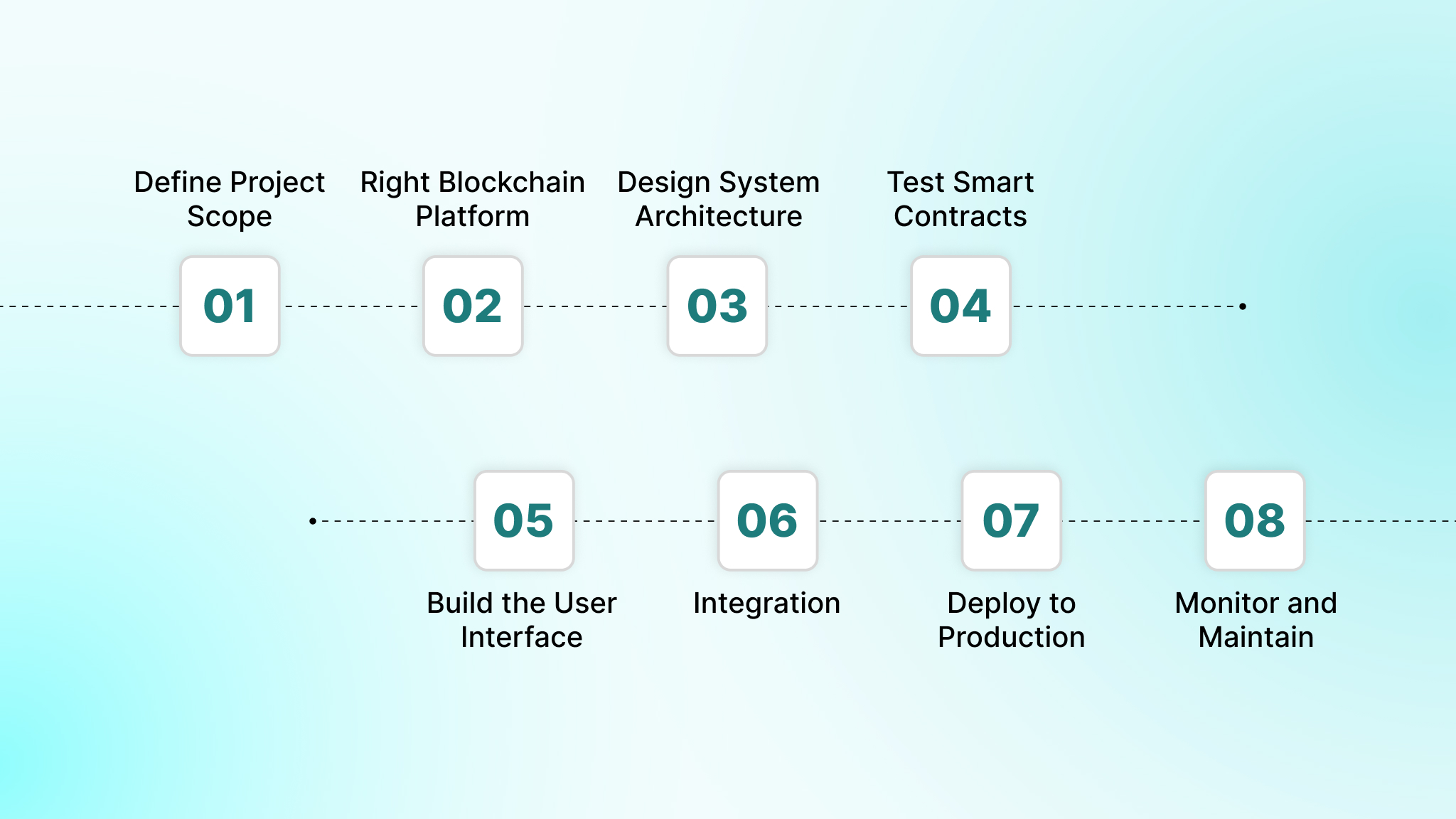
Building a production blockchain application requires a structured approach to execution. If you skip steps, issues usually surface later as security gaps, performance bottlenecks, or compliance risks.
1. Define Project Scope and Requirements
Start with your business problem. Clearly document:
- What data or transactions do you need to record on-chain
- Who participates in the network and what permissions they require
- Which events should trigger smart contract execution
- How the application integrates with existing systems
- Your performance expectations, including transaction volume and latency.
Define user roles early. In a supply chain application, for example, manufacturers, logistics partners, and retailers each require different access levels and actions.
2. Choose the Right Blockchain Platform
Your platform choice affects development speed, operating cost, governance, and scalability. You should evaluate platforms based on decentralization requirements, transaction fees, ecosystem maturity, and compliance constraints.
Common options include:
- Ethereum is when you need open networks and mature tooling.
- Hyperledger Fabric for permissioned, enterprise-controlled environments.
- Solana for high-throughput use cases.
- Polygon for Ethereum compatibility with lower costs.
- Binance Smart Chain for cost-sensitive consumer applications.
3. Design System Architecture
Most blockchain applications use a layered architecture:
- Application layer: Mobile or web interfaces connected through Web3 libraries.
- Smart contract layer: On-chain logic is kept minimal to reduce cost and risk.
- Integration layer: APIs that connect blockchain networks to enterprise systems.
- Data layer: Hybrid storage, with high-value transactions on-chain and operational data off-chain.
At this stage, you decide what belongs on-chain, how the state is synchronized, how nodes are managed, and how private keys are secured.
4. Develop and Test Smart Contracts
Smart contracts execute exactly as written and are difficult to modify after deployment. You should keep contracts modular and minimal, using established libraries whenever possible.
Your testing process should include:
- Unit and integration tests.
- Gas usage optimization.
- Testnet deployment under realistic conditions.
- Independent security audits before mainnet release.
5. Build the User Interface
Blockchain complexity should not surface in your user experience. Your application layer must:
- Abstract wallet management and transaction signing.
- Provide clear transaction status and confirmation feedback.
- Handle failed or delayed transactions gracefully.
- Reduce blockchain calls by caching and managing local state.
Your interface must remain responsive while waiting for on-chain confirmation.
6. Integrate with Existing Enterprise Systems
Blockchain applications rarely operate in isolation. You should plan for:
- Event-driven updates from smart contracts.
- API gateways for ERP, CRM, and internal systems.
- Message queues for asynchronous processing.
- Regular reconciliation between on-chain and off-chain data.
Middleware should handle authentication, rate limiting, and error recovery.
7. Deploy to Production
Production deployment should be controlled and incremental. Before launch, ensure you:
- Complete all security reviews.
- Validate behavior on test networks.
- Automate deployment scripts.
- Configure monitoring and alerting.
- Roll out to limited users or transaction volumes first.
Deploy during periods of low network congestion to manage costs.
8. Monitor and Maintain
Once live, you need ongoing operational oversight. Monitor:
- Transaction success and failure rates.
- Gas usage and cost trends.
- Smart contract events and anomalies.
- Wallet balances for operational accounts.
- Network congestion is affecting confirmation times.
Operational dashboards should combine on-chain metrics with standard application performance indicators.
Building your first blockchain application and need technical guidance? DEVtrust’s development team can accelerate your timeline and reduce technical risk.
How Much Does Blockchain App Development Cost?
The cost of blockchain app development is not fixed. It is the sum of multiple technical and operational components, each driven by risk, security, and system complexity.
However, you can use this formula to get an estimate of the cost of development:
Total Cost = Application Development + Smart Contracts + Security & Audits + Infrastructure + Ongoing Operations
Apart from that, let’s look at the most common cost range estimate.
Cost breakdown by project complexity
| Complexity Level | Features | Timeline | Development Cost |
|---|---|---|---|
| Basic MVP | Simple token, basic wallet, single smart contract. | 2-3 months | $30,000 – $60,000 |
| Moderate | Multiple smart contracts, user authentication, payment integration, basic admin panel. | 4-6 months | $60,000 – $120,000 |
| Complex | Advanced DeFi functionality, cross-chain integration, complex tokenomics, and enterprise integrations. | 6-12 months | $120,000 – $250,000+ |
| Enterprise-Grade | Full platform with multiple modules, regulatory compliance, high security requirements, and extensive integrations. | 12-18 months | $250,000 – $500,000+ |
Cost optimization strategies
- Start with MVP: Build core functionality first. Test market fit before investing in comprehensive features. A $40,000 MVP validates your concept and de-risks the larger investment.
- Use established protocols: Leverage OpenZeppelin contracts, Uniswap liquidity protocols, or existing DeFi infrastructure rather than building from scratch. Cut development time by 30-40%.
- Choose cost-effective platforms: If Ethereum’s gas fees don’t fit your business model, evaluate Polygon or BNB Chain. Polygon reduces Ethereum gas costs by up to 95% while maintaining EVM compatibility.
- Outsource strategically: Partnering with specialized development firms provides access to experienced teams at project-based pricing that’s more predictable than hiring.
The most expensive blockchain projects share common mistakes: unclear requirements leading to scope creep, choosing inappropriate platforms that require later migration, insufficient testing resulting in post-launch fixes, and skipping security audits that later require extensive remediation.
Define your requirements precisely, select platforms that meet your needs, and allocate a sufficient security budget. These decisions made correctly the first-time cost far less than fixing them in production.
Challenges Businesses Face in Blockchain Mobile App Development and How to Address Them
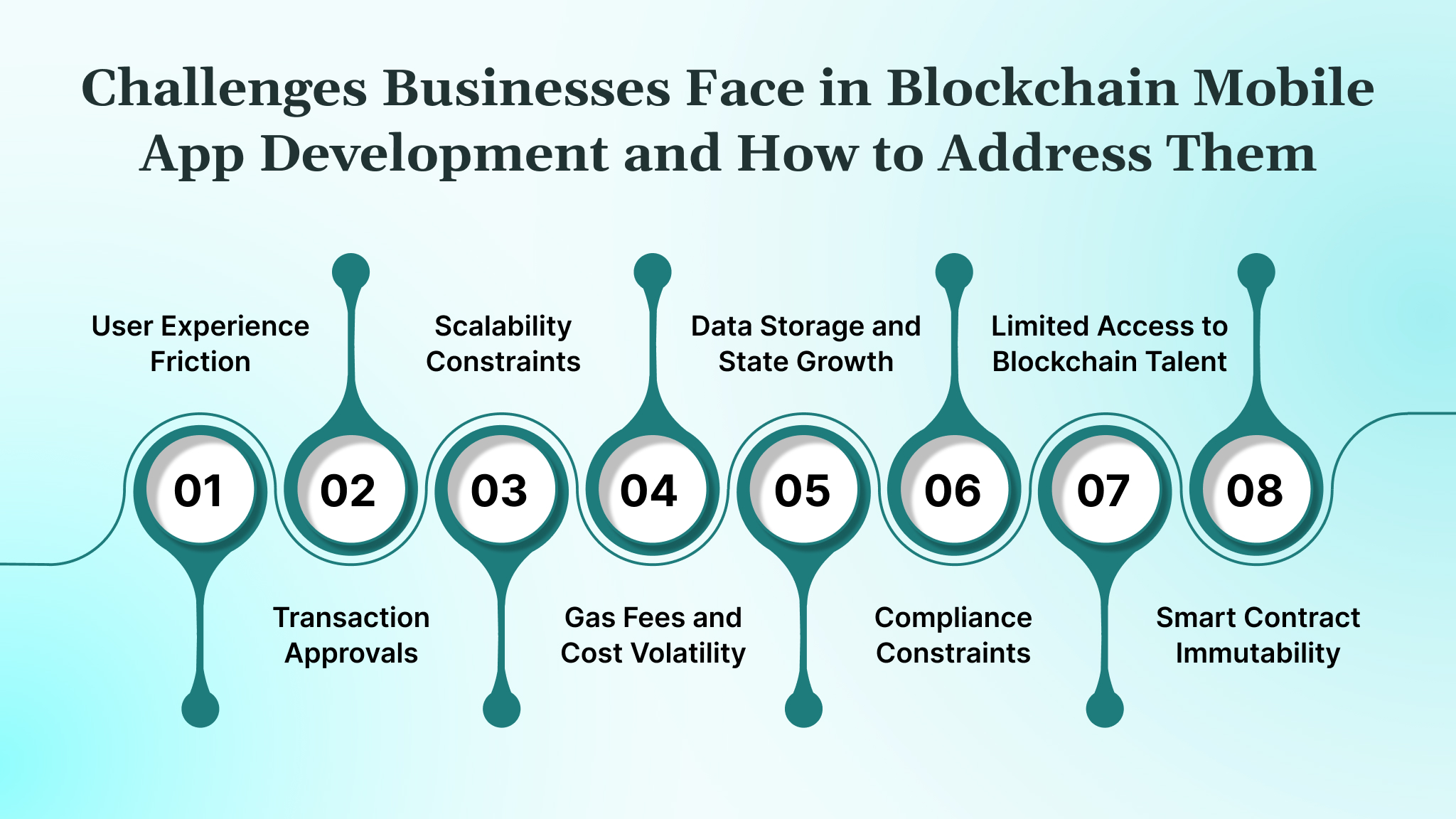
Blockchain mobile apps introduce capabilities that traditional apps cannot, but they also pose unique challenges. Understanding these issues early allows you to design systems that are usable, scalable, and compliant from day one.
User Experience Friction and Adoption Barriers
Blockchain interactions feel unfamiliar to most users. Wallets, private keys, transaction approvals, and fees introduce complexity that can slow adoption.
Users are often required to install wallets, manage private keys, and understand that lost credentials cannot be recovered. This creates friction compared to familiar login-based systems.
How to address it
- Use custodial or hybrid wallet models for non-critical applications.
- Implement social recovery or backup mechanisms for account access.
- Design onboarding flows that explain blockchain concepts in simple terms.
- Use account abstraction to reduce users’ direct wallet management.
Transaction Approvals and Confirmation Delays
Every blockchain action requires explicit user approval and network confirmation. This breaks the expectation of instant feedback common in mobile apps.
On networks like Ethereum, confirmations can take 12–15 seconds or longer during congestion, which feels slow to users.
How to address it
- Show optimistic UI updates while transactions confirm in the background.
- Provide clear transaction status indicators.
- Allow users to continue using the app while confirmations are in progress.
- Use faster networks or Layer 2 solutions where latency matters.
Performance and Scalability Constraints
Blockchains process far fewer transactions per second than traditional databases. This limits how much logic can safely run on-chain.
High-throughput applications struggle if every action requires a blockchain transaction.
How to address it
- Keep only high-value or trust-critical actions on-chain.
- Store operational data off-chain in traditional databases.
- Use Layer 2 scaling solutions for higher throughput.
- Batch multiple actions into a single transaction when possible.
Gas Fees and Cost Volatility
On public blockchains, transaction fees fluctuate based on network demand. Fee spikes can disrupt pricing models and user experience.
Unpredictable costs make it difficult to plan usage-based features.
How to address it
- Build on Layer 2 networks with more stable fees.
- Monitor gas prices and delay non-critical transactions during spikes.
- Use meta-transactions in which the application sponsors the fees.
- Design workflows that limit how often users trigger transactions.
Data Storage and State Growth
Blockchain state grows continuously. Storing large amounts of data on-chain increases infrastructure cost and operational complexity.
Running full nodes becomes increasingly expensive over time.
How to address it
- Store only hashes or proofs on-chain.
- Use IPFS or permanent storage solutions for large files.
- Rely on managed or archival node providers.
- Design contracts that minimize on-chain state usage.
Regulatory and Compliance Constraints
Blockchain’s global nature often conflicts with jurisdiction-specific regulations.
Financial and healthcare applications face additional challenges around data privacy, identity verification, and audit access.
How to address it
- Keep personal and sensitive data off-chain.
- Use permissioned or hybrid networks when required.
- Implement identity verification before allowing transactions.
- Maintain clear documentation of compliance and data-handling practices.
Limited Access to Blockchain Talent
Experienced blockchain developers remain scarce and expensive. Building and maintaining in-house teams is difficult for many businesses.
This shortage can slow development and increase risk.
How to address it
- Partner with specialized blockchain development teams.
- Upskill existing engineers instead of hiring exclusively.
- Use mature platforms with strong developer ecosystems.
- Avoid unnecessary custom implementations.
Smart Contract Immutability and Upgrade Risk
Once deployed, smart contracts are difficult to change. Bugs or flawed logic can have permanent consequences.
Without proper controls, even small mistakes can become critical issues.
How to address it
- Invest heavily in testing and security audits.
- Use upgradeable contract patterns where appropriate.
- Implement time-locks and emergency pause mechanisms.
- Limit contract scope to reduce the attack surface.
Also Read: Top 10 Custom Software Development Companies in 2026
Real-World Use Cases and Examples of Blockchain Apps
Blockchain apps deliver value by reducing friction between parties, automatically enforcing trust, or creating verifiable records that traditional systems struggle to maintain. Below are real-world use cases where blockchain app development is already producing measurable outcomes.
Financial Services and Payments
Blockchain apps are widely used in financial systems where transaction integrity, traceability, and settlement speed matter.
These applications typically support:
- Cross-border payments with fewer intermediaries.
- Real-time settlement instead of multi-day clearing.
- Transparent transaction histories for audits and compliance.
- Automated execution of payment rules through smart contracts.
Common examples include digital wallets, remittance platforms, invoice financing tools, and asset tokenization systems.
A well-known example of this approach is Ripple, which uses blockchain infrastructure to help financial institutions move funds across borders more efficiently.
Supply Chain and Logistics
In supply chain environments, data is shared across manufacturers, logistics providers, distributors, and retailers. Blockchain apps provide a shared, tamper-resistant source of truth.
Typical use cases include:
- End-to-end shipment tracking.
- Proof of origin and product authenticity.
- Automated milestone verification and handoffs.
- Dispute reduction through shared audit trails.
These systems are often accessed in real time through mobile apps used by drivers, warehouse teams, and partners.
Healthcare and HealthTech Platforms
Healthcare blockchain apps focus on data integrity and controlled access rather than full decentralization.
They are commonly used for:
- Verifying medical records without exposing patient data.
- Secure sharing of health data across providers.
- Maintaining audit trails for compliance.
- Consent management for data access.
In most cases, sensitive records remain off-chain, while the blockchain is used for verification and access logging.
Digital Identity and Access Management
Blockchain enables portable, user-controlled identity systems that reduce reliance on centralized identity providers.
Applications in this space support:
- Secure identity verification without repeated data sharing.
- Verifiable credentials for education, employment, or access control.
- Reduced fraud through cryptographic proofs.
- Simplified onboarding across multiple platforms.
These apps are especially useful in fintech, education, and enterprise access management.
Real Estate and Asset Tokenization
Blockchain apps are increasingly used to digitize ownership and transaction records for physical and digital assets.
Common use cases include:
- Tokenized ownership of real estate or assets.
- Transparent transaction histories.
- Automated escrow and settlement.
- Fractional ownership models.
Mobile apps allow investors and stakeholders to track ownership and transactions in real time.
Gaming, Digital Assets, and Marketplaces
In gaming and digital commerce, blockchain apps enable true ownership of digital assets.
These applications support:
- In-game asset ownership and transfer.
- Player-driven marketplaces.
- Interoperable digital items across platforms.
- Transparent royalty and revenue distribution.
Blockchain ensures asset authenticity while mobile apps provide the user experience layer.
Enterprise Automation and Smart Workflows
Many enterprises use blockchain to automate cross-organizational workflows rather than consumer-facing products.
These systems are used for:
- Contract lifecycle automation.
- Multi-party approvals and verification.
- Compliance reporting and audit readiness.
- Secure data exchange between business units.
Blockchain acts as a coordination layer, while existing enterprise systems handle core operations.
Leading Blockchain App Development Trends in 2026
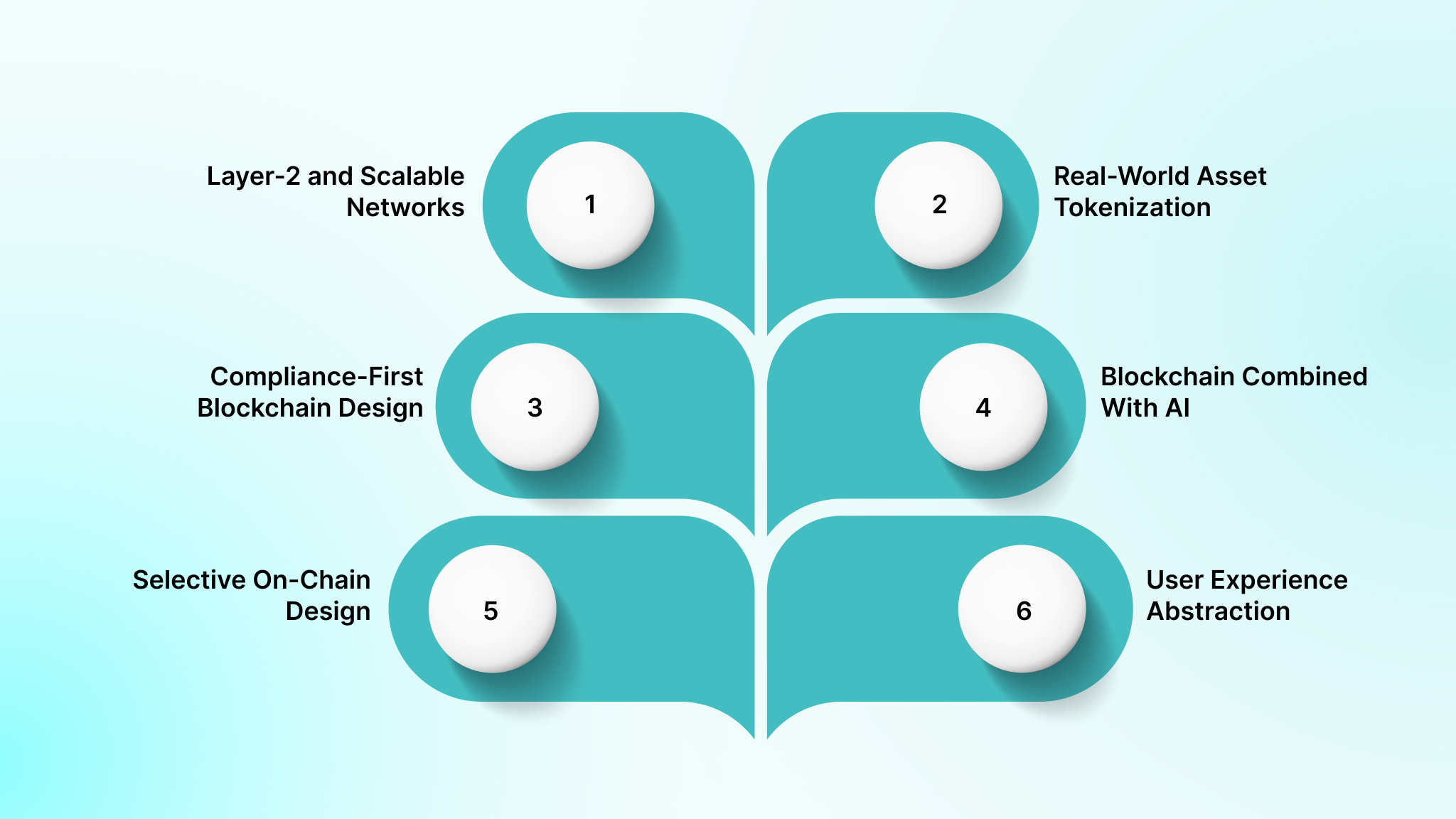
Blockchain trends only matter if they translate into measurable business outcomes. The most successful teams are not adopting blockchain for novelty; they are using specific patterns that reduce cost, improve speed, or unlock new revenue.
Here is what businesses are gaining by following today’s trends.
Layer-2 and Scalable Networks Are Reducing Operating Costs
Many teams have moved away from relying solely on Layer-1 blockchains because transaction fees and latency directly impact user adoption.
By using Layer-2 networks and scalable chains, businesses are:
- Reducing transaction costs by up to 90 percent.
- Delivering faster confirmations for mobile users.
- Making transaction pricing predictable at scale.
This allows applications to support higher usage volumes without costs increasing linearly with growth.
Real-World Asset Tokenization Is Unlocking New Revenue Models
Tokenization is no longer limited to experimental financial products. Businesses are applying it to real assets and operational workflows.
Companies using this trend are:
- Enabling fractional ownership of previously illiquid assets.
- Speeding up settlement and transfer processes.
- Creating new participation models for users and investors.
The return comes from improved liquidity, reduced administrative overhead, and broader market access.
Compliance-First Blockchain Design Is Reducing Risk and Rework
Early blockchain projects often treated compliance as an afterthought. That approach has proven costly.
Teams designing compliance into their architecture upfront are:
- Shortening approval and audit cycles.
- Avoiding expensive platform redesigns later.
- Gaining faster internal and regulatory buy-in.
This trend is especially valuable in regulated industries where risk reduction directly protects ROI.
Blockchain Combined With AI Is Improving Decision Confidence
AI systems are only as reliable as the data they use. Blockchain is increasingly used to strengthen trust in automated workflows.
Businesses applying this approach are:
- Verifying the source and integrity of data used by AI models.
- Creating audit trails for automated decisions.
- Reducing liability in high-impact use cases.
The result is automation that scales without sacrificing accountability.
Selective On-Chain Design Is Improving Performance
High-ROI blockchain apps no longer put every process on-chain. Instead, they use blockchain only where immutability and verification matter.
Teams following this pattern are:
- Lowering development and transaction costs.
- Improving application performance.
- Simplifying upgrades and long-term maintenance.
This hybrid approach keeps blockchain as an asset rather than a bottleneck.
User Experience Abstraction Is Driving Adoption
Apps that expose wallets, gas fees, and confirmation delays to users struggle to scale.
Businesses prioritizing abstraction are:
- Reducing onboarding friction.
- Increasing transaction completion rates.
- Delivering experiences closer to traditional apps.
By hiding the complexity of blockchain, these teams improve both adoption and retention.
Why Partner With DEVtrust for Blockchain App Development?
When you’re evaluating technology partners, you need more than developers; you need a team that understands your business, your users, and your long-term goals. DEVtrust is built for exactly that.
DEVtrust is a full-service software development and IT solutions partner that helps businesses design, build, and scale high-impact digital products tailored to real business needs. With over 7+ years of experience, 120+ specialists, and more than 150 successful projects, DEVtrust combines technical excellence with disciplined delivery to drive measurable results.
DEVtrust gives you:
Blockchain Expertise Focused on Real-World Outcomes
Building a blockchain application is not just about writing smart contracts. It involves architectural decisions that affect security, performance, compliance, and long-term cost.
DEVtrust helps you navigate these decisions with clarity. The team works closely with you to:
- Identify where blockchain adds real value versus where traditional systems are more efficient.
- Design architectures that balance on-chain trust with off-chain performance.
- Build secure, auditable smart contracts ready for production.
- Deliver mobile and web experiences that hide blockchain complexity from end users.
The focus is always on building systems that work reliably in real-world conditions, not on experimental proofs that stall after launch.
Experience Across High-Impact Blockchain Use Cases
DEVtrust applies blockchain where trust, transparency, and automation directly impact business performance. This includes:
- Payment and settlement platforms that reduce reconciliation overhead.
- Supply chain systems that improve traceability and dispute resolution.
- Identity and access workflows that require verifiable credentials.
- Tokenized assets and ownership models with clear governance.
- Enterprise workflows that require multi-party approvals and auditability.
Each solution is designed with scalability, compliance, and maintainability in mind.
A Delivery Model That Reduces Blockchain Risk
Blockchain projects carry a higher risk than traditional applications if execution is rushed or poorly structured. DEVtrust mitigates this through a disciplined delivery approach that includes:
- Early feasibility and architecture validation.
- Clear scope definition and cost forecasting.
- Security-first development and testing practices.
- Ongoing support, monitoring, and optimization after launch.
This approach helps you avoid costly redesigns, security issues, and performance bottlenecks later in the product lifecycle.
If you’re exploring blockchain to improve trust, automation, or coordination in your product, DEVtrust helps you move forward with confidence.
Conclusion
Blockchain app development succeeds when you start with a clear business problem and choose the right technical approach to solve it. The technology provides real value in scenarios requiring transparent audit trails, multi-party coordination, or trustless automation. It adds unnecessary complexity when traditional databases would suffice.
The decision to build blockchain applications comes down to three factors: whether blockchain solves a measurable problem, if you can navigate the regulatory landscape for your industry, and whether your team has access to the specialized technical expertise required for successful implementation.
DEVtrust brings seven years of blockchain development experience, successful deployments across FinTech, HealthTech, and logistics, and the technical depth to guide you from concept to production. We help you avoid expensive mistakes through honest technical assessment and proven implementation processes.
Schedule a free consultation to discuss your blockchain project requirements and determine whether blockchain provides ROI for your specific use case.
Frequestly Asked Questions
Related Articles
Mobile App Development
App Development Cost in Singapore 2026: Complete Guide
Mobile App Development
A Step-by-Step Framework for Business Mobile App Development
Mobile App Development