Software development has grown more complex in recent years, but choosing the right programming language can make a big difference. Python has emerged as a go-to choice for developers, startups, and large enterprises because it can handle everything from web apps to AI and cloud systems.
Its popularity is reflected in market growth: the global Python web frameworks market was valued at USD 18.21 billion in 2024 and is expected to reach USD 177.78 billion by 2032. This growth shows how Python continues to shape software development worldwide.
In this blog, we will explore Python software development in 2026, including its features, advantages, frameworks, industry use cases, and how to develop software in Python effectively.
Overview
- Python powers scalable web platforms, AI/ML workflows, automation, and cloud-native systems across FinTech, HealthTech, SaaS, and data-intensive industries.
- Its clean syntax and cross-platform support reduce technical debt, boost onboarding, and maintain complex software with minimal friction.
- Frameworks like Django, FastAPI, TensorFlow, and PyTorch enable secure backend APIs, predictive modeling, and intelligent automation without extensive custom tooling.
- Effective Python projects require goal alignment, architecture planning, CI/CD pipelines, automated testing, and regulatory compliance for production-grade reliability.
- DEVtrust delivers full-stack Python solutions, AI/ML integration, microservices, and cloud-native deployments.
What is Python?
Python is a high-level, interpreted programming language introduced by Guido van Rossum in 1991 and engineered for fast, reliable software development. In 2026, Python is firmly centered around Python 3.x, which delivers mature async support, better memory management, and performance gains through ongoing interpreter optimizations.
Unlike compiled languages that require build pipelines, Python executes code directly, enabling rapid iteration during development and testing. It supports procedural, object-oriented, and functional paradigms, allowing you to design flexible architectures based on project needs. Python runs consistently across Windows, macOS, and Linux, simplifying multi-environment deployments.
Enterprises and startups rely on Python to ship scalable web platforms, AI-driven systems, and cloud-native applications faster, with lower engineering friction and long-term maintainability.
Having understood Python’s fundamentals, it’s important to see why it stands out for software development today.
Also Read: 7 Benefits of Augmented Reality in Education With Examples
Why Choose Python for Software Development?
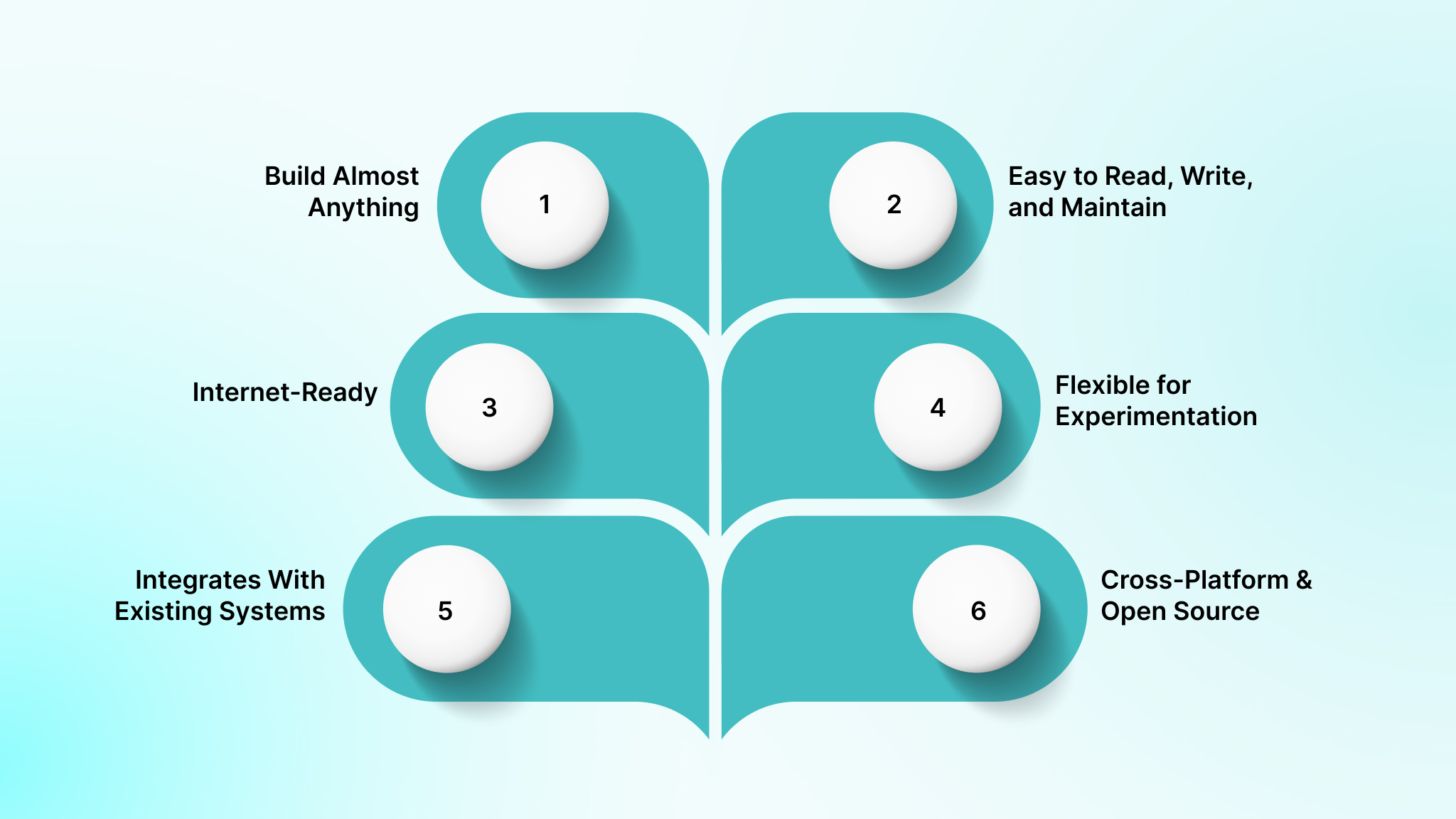
In 2026, Python is deeply embedded in how modern software is designed, deployed, and scaled. Its strength lies in supporting cloud-native systems, AI-driven products, and fast-moving engineering teams without forcing rigid architectural choices. Below is why Python continues to dominate production environments:
1. Build Almost Anything
Python helps you to build full-scale web platforms, mobile app backends, machine learning pipelines, automation tools, and data engineering workflows using a single language. For example, Netflix relies on Python with PyTorch for recommendations, while Instagram uses Django to reliably serve millions of concurrent users.
2. Easy to Read, Write, and Maintain
Python’s human-readable syntax reduces cognitive load for engineers, leading to fewer defects and faster reviews. Enterprises benefit from quicker onboarding and lower technical debt. Large systems like OpenStack prove Python codebases remain maintainable even as features, contributors, and complexity increase over time.
3. Internet-Ready
Python is designed for networked software. Frameworks like FastAPI and Django support REST, GraphQL, async APIs, and background workers. Python also integrates seamlessly with AWS, Azure, and GCP services, making it ideal for SaaS platforms, serverless functions, and API-driven architectures.
4. Flexible for Experimentation
Python allows rapid iteration without heavy tooling overhead. Teams prototype features, test algorithms, and validate ideas quickly. Data scientists experiment with models using TensorFlow or Scikit-learn, while backend engineers adjust service logic without destabilizing production systems or slowing release cycles.
5. Integrates With Existing Systems
Python acts as a connector across heterogeneous environments. Enterprises use it to bridge Java or .NET systems with microservices, APIs, and data platforms. In regulated sectors like finance and healthcare, Python connects legacy systems with analytics, reporting, and automation layers efficiently.
6. Cross-Platform & Open Source
Python runs consistently on Windows, macOS, and Linux, enabling unified development and deployment strategies. Its open-source ecosystem eliminates licensing costs and vendor dependency. Organizations can scale globally with a single codebase while benefiting from continuous improvements driven by the Python community.
Now that we know why Python is widely adopted, let’s dive into the specific advantages it offers Python software developers and enterprises when building production-grade applications.
Advantages of Software Development with Python
Python enables you and your team to build, iterate, and scale modern software faster by combining development speed, architectural flexibility, and enterprise-grade ecosystem support. Here are all the advantages of software development in Python:
- Rapid Development & Lower Costs: Interpreted execution and dynamic typing eliminate compile delays, enabling rapid iteration and reducing MVP timelines by 30-40% versus Java or C++ stacks.
- Vast Ecosystem & Versatility: Mature libraries support data engineering, API development, AI/ML, and cloud workloads, minimizing custom tooling and supporting delivery across diverse software architectures.
- Strong Community & Talent Pool: A global developer base ensures access to backend, data, and AI specialists, supported by stable documentation and actively maintained open-source frameworks.
- Scalability & Integration: Python scales through microservices, containerization, and Kubernetes orchestration, integrating seamlessly into CI/CD pipelines for controlled releases and cloud-native growth.
- Security & Compliance: Framework-level protections and compatibility with enterprise security tooling support HIPAA, PCI-DSS, and SOC2 compliance in regulated software environments.
While Python offers flexibility and speed, it’s not perfect. Understanding its limitations is equally important to planning robust, reliable, and high-performance software systems.
Limitations of Python for Software Development
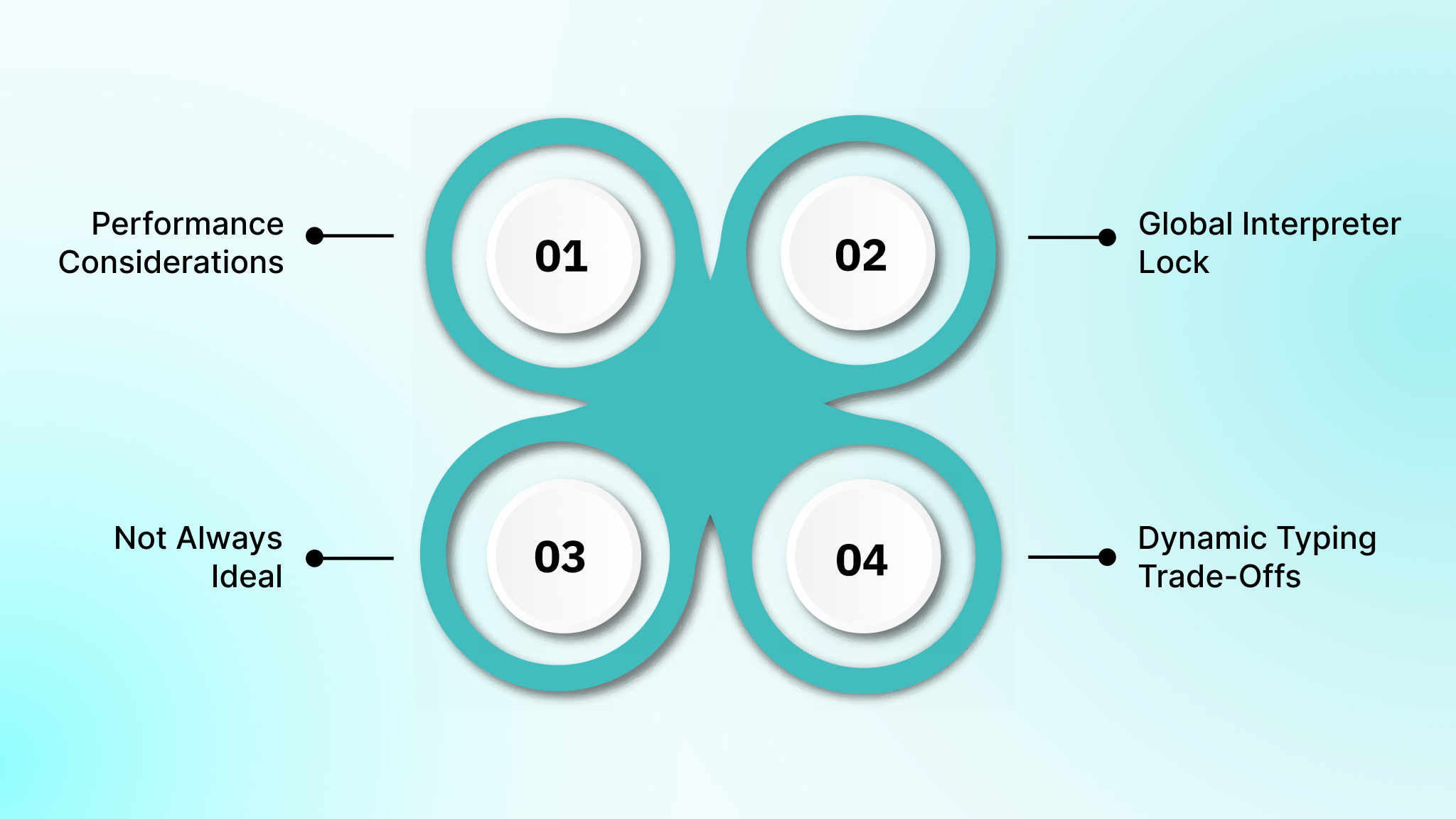
Python’s flexibility introduces certain constraints that must be addressed. Here are the limitations of Python:
- Performance Considerations: Python underperforms in CPU-bound workloads like real-time simulations or trading systems, often requiring C++, Rust, or Go services for performance-critical execution paths.
- Global Interpreter Lock (GIL): The GIL restricts true multi-threaded parallelism within a process, pushing high-concurrency systems toward multiprocessing, async frameworks, or distributed task-based architectures.
- Not Always Ideal: Python is unsuitable for native mobile apps, embedded systems, or low-memory environments, where platform-specific languages or hybrid architectures deliver better efficiency.
- Dynamic Typing Trade-offs: Dynamic typing increases runtime error risk in large systems, making rigorous testing, type hints, and static analysis essential for production reliability.
Once you know Python’s strengths and weaknesses, it’s useful to see which frameworks and tools help boost development, ensure reliability, and scale production systems efficiently.
Python Frameworks and Tools
Python’s ecosystem equips development teams with production-ready frameworks and tooling that boost delivery while supporting scalability, maintainability, and long-term system reliability. This includes:
- Full-Stack Frameworks: Django provides built-in ORM, authentication, and admin tooling, enabling rapid development of secure, database-driven backend systems with minimal configuration overhead.
- Micro-Frameworks: Flask and FastAPI support lightweight, API-first architectures, ideal for microservices, async processing, and high-performance backend services in cloud-native setups.
- AI & Machine Learning Frameworks: TensorFlow, PyTorch, and Scikit-learn enable predictive modeling, inference pipelines, and intelligent features within data-driven software applications.
- Automation & Testing Frameworks: Robot Framework, Selenium, and PyTest simplify automated testing, regression coverage, and QA workflows across complex software systems.
- Development Tools & IDEs: PyCharm, VS Code, and Jupyter Notebook support debugging, refactoring, and exploratory development, improving productivity across backend and data teams.
- Package Management & CI/CD: pip, Poetry, and Conda manage dependencies, while GitHub Actions, Jenkins, and CircleCI power automated testing, builds, and deployment pipelines.
Having explored the ecosystem, let’s move into a practical, step-by-step approach to building Python software projects, aligning business goals with technical execution and architecture.
Step-by-Step Guide to Software Development Using Python
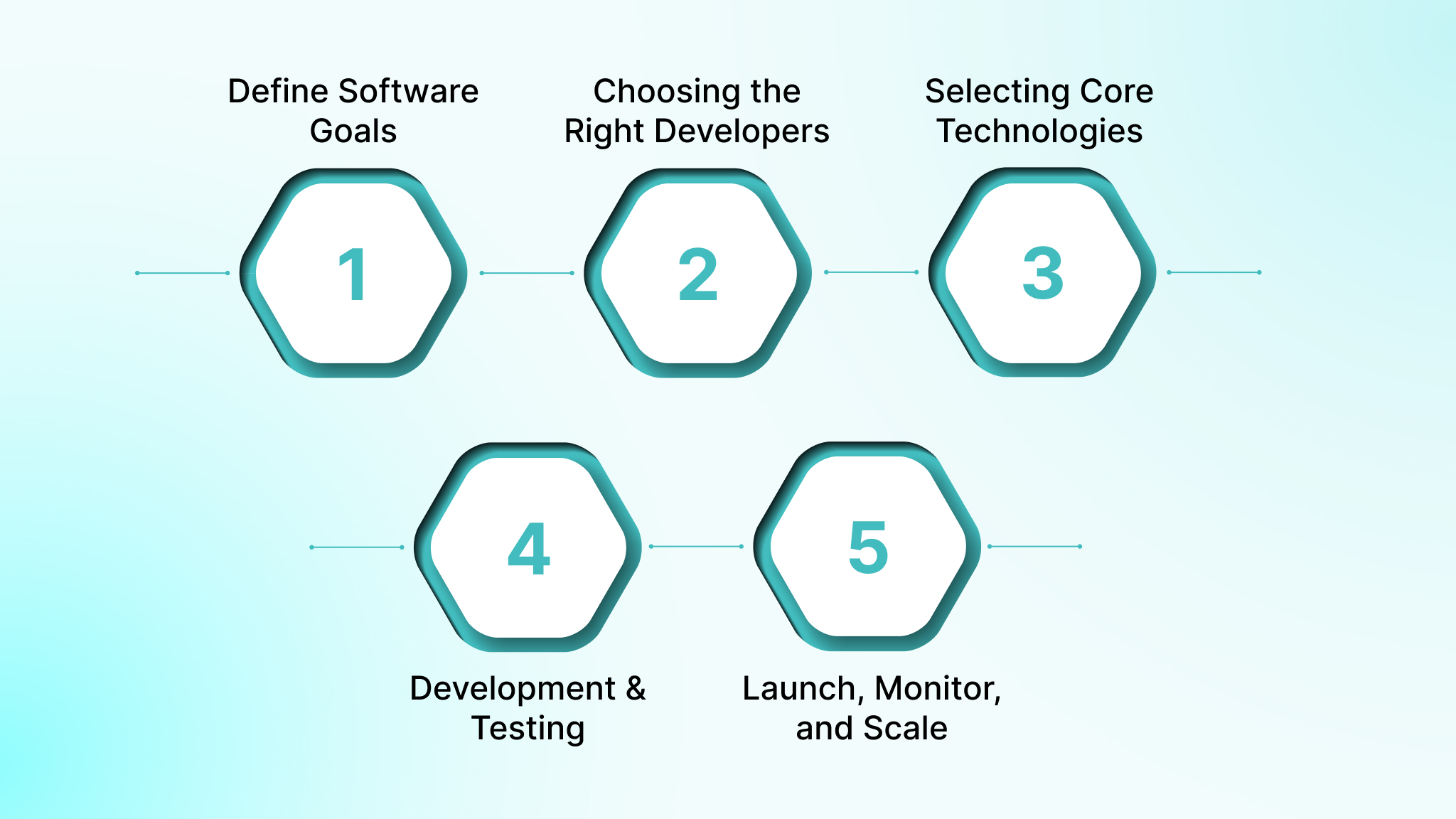
A successful Python project requires more than writing clean code. It demands alignment between business goals, technical architecture, security, and long-term scalability. Below is a practical, implementation-focused approach used in production-grade Python systems.
1. Define Software Goals
This stage translates business intent into technical requirements. Clear goal definition prevents scope creep and ensures your architectural decisions support growth, compliance, and performance from day one.
How to implement:
- Document the core business problem and primary user workflows
- Define performance benchmarks (latency, throughput, uptime)
- Identify regulatory requirements such as HIPAA, PCI-DSS, or SOC2
- Estimate scale targets: users, data volume, API traffic growth
2. Choosing the Right Developers & Team Composition
Python projects succeed when skills match workload complexity. Team structure directly impacts delivery speed, system reliability, and integration quality.
How to implement:
- Assign full-stack Python engineers for core application logic
- Include AI/ML engineers for data-driven or predictive features
- Add DevOps specialists for CI/CD, cloud automation, and monitoring
- Ensure security and compliance expertise for regulated industries
3. Selecting Core Technologies & Architecture
Technology choices define how well the system scales, integrates, and remains maintainable. Python excels when paired with cloud-native, modular architectures.
How to implement:
- Choose Django for monolithic or enterprise backends, FastAPI for microservices
- Select PostgreSQL or MySQL for transactional data, Redis for caching
- Use AWS, Azure, or GCP for compute, storage, and managed services
- Design API-first architectures for future integrations and expansion
4. Development & Testing
Python’s speed must be balanced with quality controls. Structured development and testing reduce production failures and rework costs.
How to implement:
- Follow agile sprints with defined deliverables and reviews
- Implement CI/CD pipelines for automated builds and deployments
- Write unit, integration, and API tests using PyTest
- Perform QA on real environments to validate performance and security
5. Launch, Monitor, and Scale
Deployment is the start of system maturity, not the end. Python systems scale effectively when monitoring and optimization are built into operations.
How to implement:
- Deploy using containers and orchestration tools like Kubernetes
- Monitor latency, error rates, and resource utilization continuously
- Enable autoscaling based on traffic and workload patterns
- Optimize services incrementally without disrupting core functionality
With a structured process in place, it’s helpful to examine how Python is applied across industries, solving real-world problems with scalable, secure, and data-driven solutions.
Also Read: Online Payment Gateway Integration: A Step-by-Step Guide for 2026
Python Use Cases Across Industries
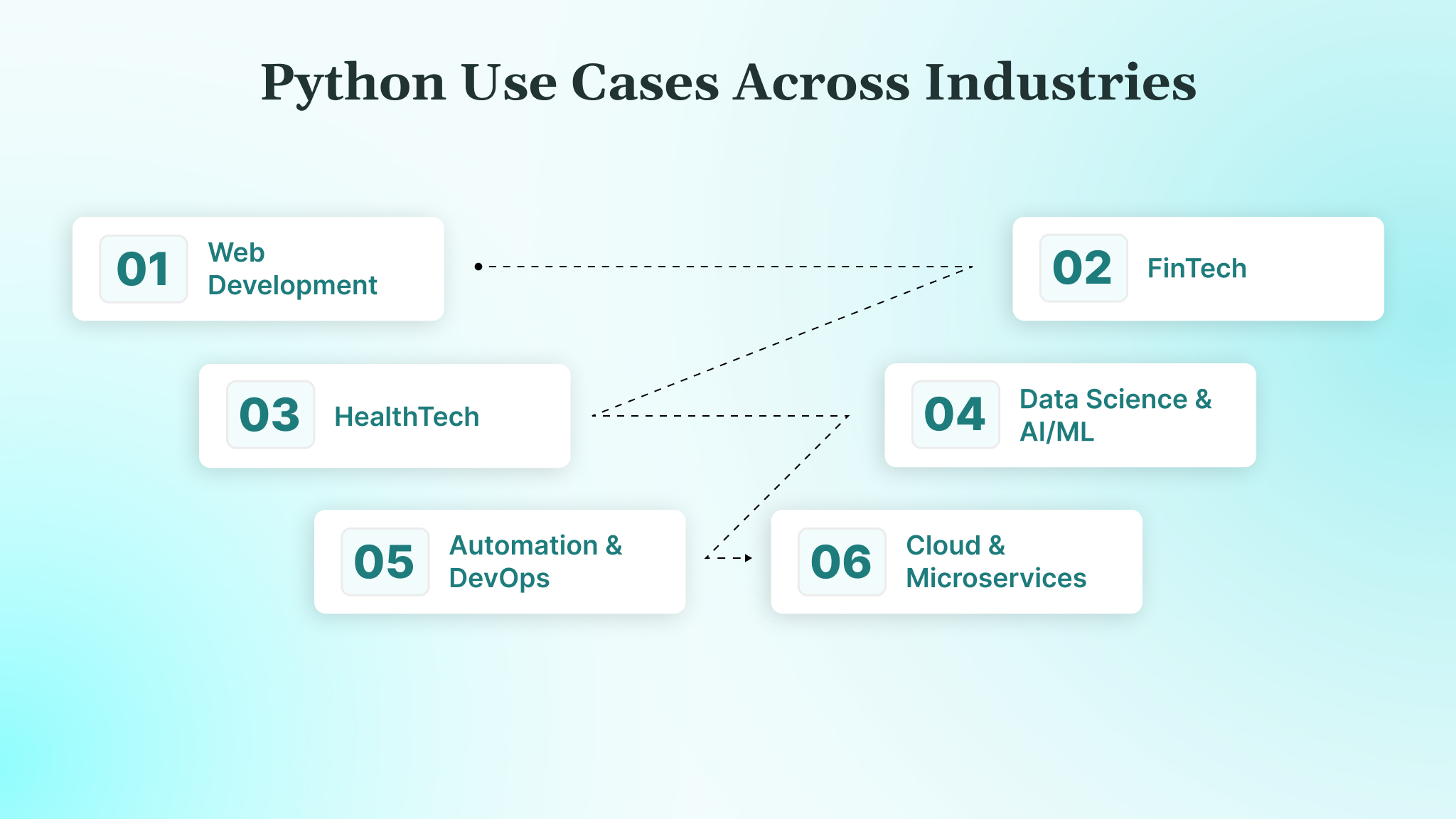
Python enables you to build and scale software across industries by supporting modern architectures, data-driven workflows, and cloud-native deployments. Here are some of its use cases:
1. Web Development
Python supports API-first web architectures using Django or Flask for authentication, data modeling, and business logic. It is commonly paired with PostgreSQL and Redis to handle high-traffic, data-driven applications.
2. FinTech
Python is used for transaction processing services, reconciliation pipelines, fraud-scoring workflows, and financial analytics. It is often integrated with Stripe, Plaid, and AML systems under PCI-DSS and SOC 2 controls.
3. HealthTech
Python enables HIPAA-compliant backend systems for patient data handling, telehealth workflows, clinical analytics, and AI-assisted documentation. It is typically integrated with EHR/EMR platforms and audit-logging infrastructure.
4. Data Science & AI/ML
Python powers model training, feature engineering, inference pipelines, and monitoring systems using TensorFlow, PyTorch, and Scikit-learn, with production deployments relying on batch jobs, APIs, and MLOps workflows.
5. Automation & DevOps
Python is used for infrastructure scripts, CI/CD orchestration, data migrations, background workers, and system health checks. It helps in reducing manual intervention across deployment, monitoring, and operational workflows.
6. Cloud & Microservices
Python runs stateless microservices and serverless functions across AWS, Azure, and GCP, supporting multi-tenant SaaS development architectures through containerization, message queues, and API gateways.
Once you understand Python’s applications, you need clarity on how project complexity, integrations, and team structures influence cost, timelines, and the best engagement models.
Cost, Timeline, and Engagement Models
When planning Python software development, you must account for how project complexity, integrations, and compliance affect costs and delivery schedules. Understanding these factors upfront ensures your team meets business goals without unexpected delays or budget overruns.
1. Cost Drivers
Your project costs are influenced by whether you are modernizing legacy Python systems or building greenfield applications. It is also impacted by the number of integrations with APIs or external services, compliance requirements like HIPAA, PCI-DSS, or SOC2, and performance SLAs.
High-volume data processing, AI/ML pipelines, or real-time workflows increase architecture and testing complexity, directly impacting budgets.
2. Timelines
You typically allocate 4-6 weeks for discovery, PoC, and architecture validation, where risk, scalability, and integration issues are identified. Core development, CI/CD setup, and system integration take 8-16+ weeks, depending on feature complexity, team size, and regulatory testing.
Continuous post-launch optimization ensures reliable scaling and stable performance.
3. Engagement Models
You rely on dedicated pods when your Python project requires full-stack delivery, strict adherence to architecture, and continuous integration. Focused initiatives suit targeted objectives like API migrations or performance stabilization.
Besides, hybrid teams combine in-house control with external execution, ideal for scaling Python applications efficiently while utilizing specialized talent.
Having planned for cost and structure, let’s see how DEVtrust supports Python projects, delivering secure, AI-integrated, cloud-native solutions with scalable architecture and compliance-ready systems.
Also Read: Mobile App Automation Testing Explained: Tools, Benefits, and Challenges
How DEVtrust Helps You Implement Python Software Development?
Building Python-based software at scale involves managing complex challenges such as integrating AI/ML workflows, ensuring regulatory compliance, maintaining microservices architecture, and achieving seamless CI/CD deployment. Teams often struggle with secure cloud integration, high-traffic scalability, and real-time data processing while keeping operational risk low.
At DEVtrust, we address these challenges by providing expert Python development teams that combine full-stack, AI/ML, and DevOps expertise. Our agile workflows and cloud-native architectures allow you to deliver robust, compliant, and scalable Python applications while reducing time-to-market and operational overhead.
For example, DEVtrust partnered with Priviscribe to deliver a HIPAA-compliant, AI-powered credential management platform, integrating MFA, automated document extraction, OpenAI form-filling, and scalable Laravel/MySQL architecture. With this, the platform achieved 45% improved operational efficiency, 35% enhanced user experience, and 95% scalability and security.
Key Capabilities of DEVtrust include:
- Full-Stack Python Development: End-to-end implementation of Django, Flask, or FastAPI backends with PostgreSQL, Redis, and containerized deployment.
- AI/ML Integration: Seamless integration of TensorFlow, PyTorch, and Scikit-learn pipelines for predictive analytics, recommendation systems, and intelligent automation.
- HIPAA/PCI-DSS/SOC2 Compliance: Build secure, regulated applications for healthcare, FinTech, and enterprise domains with audit-ready security measures.
- Microservices & Multi-Tenant Architecture: Scalable, cloud-native systems deployed on AWS, Azure, or GCP for high-concurrency workloads and multi-tenant SaaS platforms.
- Testing, QA, & CI/CD Pipelines: Automated testing, real-device QA, and fully managed CI/CD ensure reliability, rapid iteration, and minimized downtime.
With this approach, DEVtrust ensures your Python projects not only meet functional requirements but also adhere to modern performance, security, and compliance standards.
Conclusion
Python continues to dominate modern software development, powering scalable web applications, AI/ML workflows, automation, and cloud-native solutions. Its readability, extensive libraries, and cross-platform support enable faster development, seamless integrations, and maintainable architectures for startups and enterprises alike.
At DEVtrust, we translate these capabilities into practical solutions. Our teams deliver full-stack Python development and build cloud-native microservices. CI/CD pipelines, automated testing, and scalable architectures guarantee reliable, high-performance software tailored to your business needs.
Book a demo with DEVtrust to boost your Python software projects, reduce development risk, and deploy secure, scalable applications that drive measurable results across industries.
Frequestly Asked Questions
Related Articles
Software Development Outsourcing
Reliable Software Development Outsourcing Services
Software Development Outsourcing
Outsource SaaS Development in 2026: Benefits and Risks
Software Development Outsourcing